
How to Choose the Right Rocket Motor for Your Build
Choosing the right rocket motor is crucial for a safe and successful model rocket launch. The motor determines your rocket's thrust, stability, altitude, and recovery system timing. Here's a quick summary of what you need to know:
- Thrust-to-Weight Ratio (TWR): Ensure a minimum TWR of 5:1. For example, a 150g rocket (1.47N) needs at least 7.35N of thrust.
-
Motor Codes: Understand codes like C6-5:
- C: Impulse class (total energy).
- 6: Average thrust in Newtons.
- 5: Delay time (seconds) before ejection charge.
- Impulse Classes: A to D are common for beginners, with higher classes requiring more space and certification in the UK.
- Delay Timing: Match delay to the rocket's coast time to ensure the parachute deploys at apogee.
- Motor Types: Black powder motors are beginner-friendly; composite motors offer more power but require advanced handling.
In the UK, all motors must comply with Health and Safety Executive (HSE) regulations and carry a CE mark. Homemade motors, including sugar motors, are illegal. Tools like OpenRocket can help simulate flights and optimise motor selection.
For beginners, start with kits like the Sky Piercer Starter Set (A–C motors) or the Cloud Raider Build Kit (D motors). Always follow safety guidelines, including proper storage, launch procedures, and legal compliance.
Key takeaway: Match motor specifications to your rocket's weight, design, and flight goals while adhering to UK safety and legal standards.
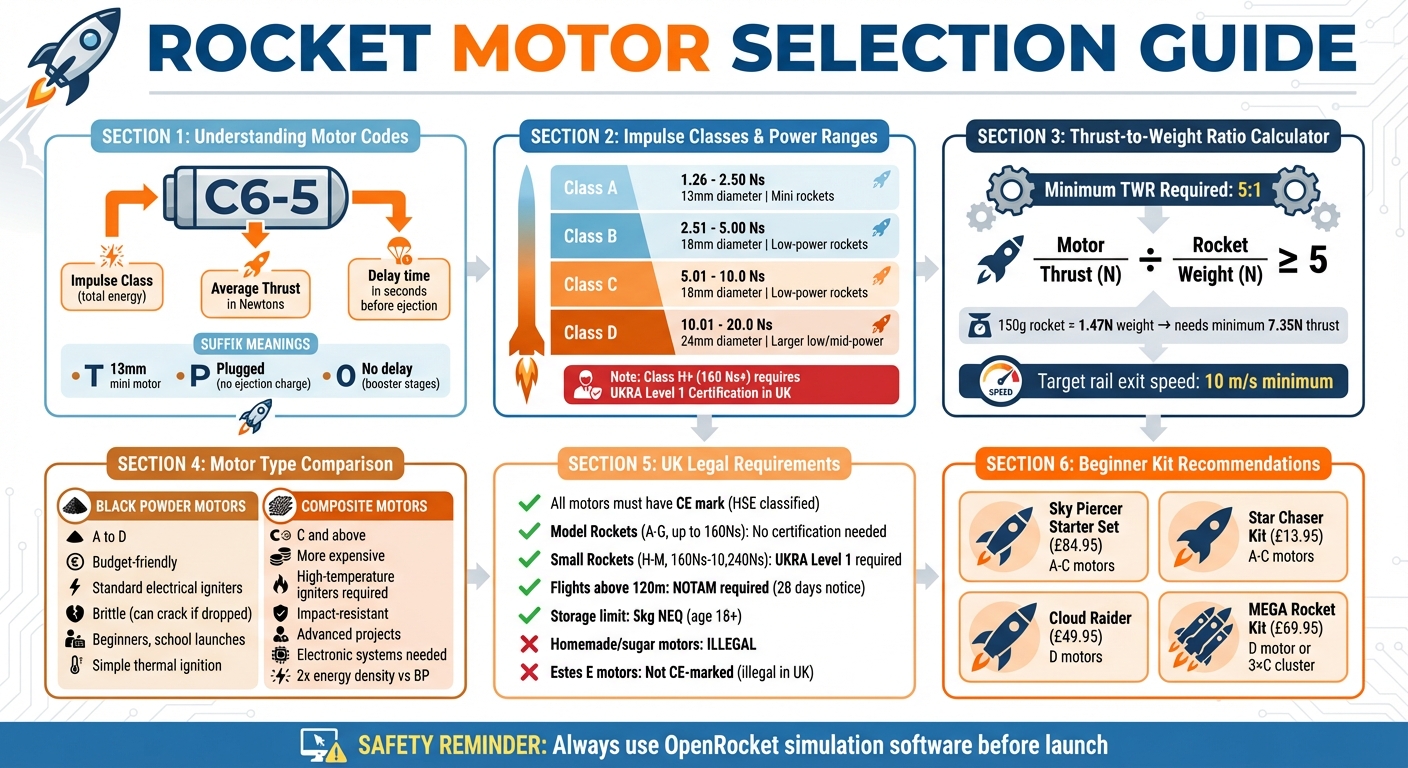
Rocket Motor Selection Guide: Classes, Thrust Requirements, and Motor Codes Explained
Rocket Motor Basics
How Rocket Motors Work
A solid rocket motor is made up of several key components: a casing, propellant, delay charge, and ejection charge. The casing, which can be crafted from materials like paper, plastic, or aluminium, houses all these elements. Inside, the propellant - a blend of fuel and oxidiser - sits above a clay nozzle at the bottom. Above the propellant is the delay charge, and at the very top, sealed by a clay cap or forward closure, lies the ejection charge.
The motor operates through four distinct stages:
- Ignition: An electrical current heats the igniter, triggering the pyrogen to ignite the propellant.
- Thrust: The propellant burns rapidly, producing hot gases that escape through the nozzle, propelling the rocket upwards.
- Coasting: During this phase, the delay charge burns slowly, emitting tracking smoke as the rocket continues its ascent to the highest point.
- Ejection: The ejection charge builds pressure, blowing off the nose cone and deploying the recovery system, such as a parachute or streamer.
These stages help explain how motor codes are used to describe a motor's performance and characteristics.
Reading Motor Codes
Motor codes, like C6-5, provide important information about a rocket motor's behaviour, including its impulse class, average thrust, and ejection delay. Here's how to break it down:
- Letter (e.g., C): Represents the impulse class, which indicates the motor's total energy capacity.
- First number (e.g., 6): Denotes the average thrust in Newtons, showing how much force the motor generates to propel the rocket.
- Second number (e.g., 5): Indicates the delay time in seconds between the end of the propellant burn and the activation of the ejection charge.
"The first letter (A, B, C etc) tells us the impulse of the motor, the first number tells us the average thrust, and the second number tells us the delay before the ejection charge is fired." - UK Rocketry Association (UKRA)
Sometimes, additional suffixes appear in motor codes. For example:
- "T" indicates a 13mm mini motor (e.g., A10-3T).
- "P" means the motor is plugged, meaning it has no ejection charge and is used with electronic recovery systems.
- "0" signifies no delay, which is common in booster stages that ignite the next motor immediately.
These codes make it easier to match a motor's specifications to your rocket's needs.
Impulse Classes and Power Ranges
Impulse classes define the motor's total energy output, with each class roughly doubling the maximum impulse of the one before it. Here’s a breakdown:
- Class A: 1.26 to 2.50 Newton-seconds
- Class B: 2.51 to 5.00 Newton-seconds
- Class C: 5.01 to 10.0 Newton-seconds
- Class D: 10.01 to 20.0 Newton-seconds
Low-power rockets typically use motors from Classes A to D, while mid-power rockets use motors ranging from Class D to G. In the UK, motors with a total impulse above 160 Newton-seconds (Class H and beyond) require Level 1 Certification from the UK Rocketry Association.
Motor diameter is another critical factor to consider. It determines whether the motor will fit your rocket's mount:
- 13mm motors: Ideal for mini rockets (usually 1/4A to A class).
- 18mm motors: Standard for low-power rockets (A to C class).
- 24mm motors: Suitable for larger low-power or mid-power rockets (commonly C to E class).
For beginners, kits like those from Rocketry for Schools often use 18mm motors for starter rockets and 24mm motors for more advanced builds. Understanding these basics will help you choose the right motor for your rocket and ensure a successful flight.
Matching Motors to Your Rocket
Thrust-to-Weight Ratio
The thrust-to-weight ratio (TWR) is a key safety measure that helps ensure your rocket has enough power to leave the launch rod safely and gain stability from aerodynamic forces. A TWR of at least 5:1 is typically recommended, meaning the motor’s thrust should be at least five times the rocket’s total flight weight.
To calculate the rocket's weight in newtons (N), convert its mass from grams to kilograms and multiply by 9.81 (gravitational acceleration). The TWR is then determined by dividing the motor’s thrust by the rocket’s weight. For example, a 160g rocket powered by a C6 motor would have a TWR of around 3.82, which falls below the safe threshold.
"As a rule of thumb you generally want at least a 5-to-1 thrust-to-weight ratio." – UKRA
If your rocket’s weight is close to the motor’s limit, it’s a good idea to review the motor’s thrust curve, particularly its initial thrust, rather than relying solely on the average thrust. Motors with a slower start might not provide enough lift-off power. Additionally, the rocket needs to reach a minimum speed of 10 m/s by the time it leaves the launch rod to ensure the fins can deliver proper aerodynamic stability.
While TWR is essential, other factors like design, stability, and weather conditions also play a role in selecting the right motor.
Factors That Affect Motor Choice
Several design elements influence motor selection beyond TWR. The rocket’s diameter and fin shape affect drag and the amount of thrust required. Slim, streamlined rockets with smaller fins usually experience less drag and perform better on the same motor compared to broader designs with larger fins.
Stability is another critical consideration, particularly the balance between the Centre of Gravity (CG) and the Centre of Pressure (CP). Heavier motors can shift the CG towards the rear, which might reduce stability. Rockets with higher drag often fly lower and may need shorter ejection delays, while sleeker rockets might require longer delays to reach apogee.
Weather conditions also influence motor choice. On windy days, motors with higher initial thrust may be necessary to achieve a quicker rail exit speed and maintain a stable, vertical trajectory. Using a longer launch rod in such conditions can also help the rocket reach the required speed for stabilisation before it transitions to free flight.
Using Flight Simulation Software
OpenRocket is a free, open-source tool that lets you simulate key flight parameters like altitude, stability, and ejection timing before launch. The software uses advanced six-degrees-of-freedom simulations with over 50 variables to evaluate whether your rocket will leave the launch rod at a safe speed, deploy its parachute at the right moment, and stay within safe altitude limits.
To ensure accurate simulations, carefully weigh all components of your rocket - right down to shock cords, adhesives, and even paint - using a digital scale. Input these precise values into the software, and use the "Custom" material option rather than generic weight overrides. This ensures the Centre of Gravity is calculated correctly. OpenRocket can identify potential issues, such as low rail exit speeds or incorrect ejection delays, helping you avoid unsafe flight outcomes.
While one study found that OpenRocket’s altitude predictions were, on average, 29% higher than actual results (with variations ranging from 0% to 43%), the software remains a valuable tool. It allows you to compare motor options and confirm that your rocket meets critical safety requirements before launch. Simulations also help fine-tune delay times and finalise motor choices, giving you greater confidence in your setup.
Selecting Motor Type and Delay Time
Black Powder vs Composite Motors
When it comes to rocket motors, beginners often start with black powder (BP) motors. These are the traditional choice in the UK for impulse classes ranging from A to D. They’re budget-friendly, easy to ignite using standard electrical igniters, and work well for straightforward staging setups. However, they do have a downside: they’re brittle. A simple drop can cause internal cracks, which may lead to motor failure.
On the other hand, composite motors, which use ammonium perchlorate (AP), start at Class C and offer about twice the energy density of BP motors. This means they deliver more thrust in a smaller and lighter motor. While they are pricier and need high-temperature igniters, they come with advantages like better impact resistance and a variety of thrust profiles, making them ideal for more advanced projects.
For school field launches, BP motors are often the go-to option. They’re straightforward to handle and don’t require the specialised ignition systems that composite motors need. BP motors also allow for simpler staging, as they can be thermally ignited from one stage to the next. Composite motors, however, usually require electronic staging systems, which can add a layer of complexity. It’s worth noting that in the UK, all motors must carry a CE mark for compliance.
Choosing an Impulse Class
Selecting the right impulse class depends on your experience, the size of your launch site, and your desired altitude. Each class represents a doubling of total impulse. For example, Class B motors deliver between 2.51 and 5.00 Newton-seconds, while Class C motors provide 5.01 to 10.0 Ns.
If you’re new to rocketry, it’s best to stick to the motor class recommended by the kit manufacturer. Once you’ve gained some confidence, you can try higher classes, but always ensure your launch site meets the minimum size requirements outlined in the UKRA Safety Codes. Larger impulse classes need more recovery space. For instance, a Class D motor is suitable for a typical school field, while Classes E or F might require a much larger area. In the UK, rockets with a total impulse of 160 Ns (Class H) or above require UKRA Level 1 Certification.
After choosing the impulse class, the next step is to determine the correct delay time for the ejection charge.
Picking the Right Delay Time
The delay time is the period, measured in seconds, between motor burnout and the activation of the ejection charge. This timing is crucial for ensuring the parachute deploys when the rocket reaches apogee - the highest point of its flight. Deploying too early or too late can damage the rocket’s airframe and recovery system.
"Ideally you want to eject your parachute as close to apogee as possible, where the rocket's velocity is minimal, thus protecting the airframe and recovery mechanism." – UKRA
For kit rockets, the manufacturer’s recommended delay is usually a safe bet. However, for scratch-built or modified designs, it’s a good idea to simulate the flight using software like OpenRocket to estimate the optimal coast time. Tim Van Milligan, owner of Apogee Components, offers this tip:
"When rounding the optimal delay value to the nearest integer, you always round downward... Lower quality rockets generally do not fly as straight, and they will reach their apogee before the predicted time in the flight."
This ensures the parachute deploys at the right moment, keeping the recovery system effective and the rocket safe. High-drag designs typically require shorter delay times, while sleek, aerodynamic rockets may need delays of 6–7 seconds. While BP motors come with fixed delays, many composite motors allow for adjustable delays, giving you more control over timing.
UK Safety and Legal Requirements
UK Safety Codes and Launch Rules
In the UK, the Civil Aviation Authority (CAA) categorises rockets based on their impulse, which determines the legal requirements for launching. Model Rockets (Classes A–G, up to 160Ns) don't need certification. However, for Small Rockets (Classes H–M, 160Ns–10,240Ns), you'll need to obtain at least UKRA Level 1 Certification before launching. So, if you're planning to go beyond Class G, completing the certification process is a must.
Only motors that are classified by the Health and Safety Executive (HSE) and carry a CE mark are legal in the UK. Popular options like Estes E motors, which aren't CE-marked, cannot be sold or used legally in the country. Additionally, making your own motors, including "sugar motors", is illegal unless you have the appropriate HSE licences.
If you plan to fly above 120 metres, you’ll need to submit a NOTAM (Notice to Airmen) to the CAA at least 28 days before the launch. Launch sites must also be located at least 5km away from commercial airports, and if you're using private land, don’t forget to obtain the landowner's permission.
For safety, the UK Rocketry Association (UKRA) advises a thrust-to-weight ratio between 5:1 and 10:1, with a minimum launch-rod-exit speed of 10m/s to ensure stability. Launch rods or rails should be positioned no more than 20 degrees from vertical, and the area around the pad must be cleared of flammable materials within a three-metre radius. Additionally, rockets shouldn't be flown in winds exceeding 20mph, though UKRA suggests keeping it under 15mph for optimal safety.
These rules are designed to ensure safe launches while maintaining compliance with UK regulations.
Storing and Handling Rocket Motors
Proper storage of rocket motors is essential for both safety and legal compliance. Anyone over the age of 18 can store up to 5kg NEQ of motors, as long as each motor contains less than 1kg NEQ, without needing an Explosives Certificate. The legal limit is determined by the propellant mass (NEQ), not the total weight of the motor, so it's a good idea to check the manufacturer's website for this information.
Motors should be stored in non-conductive, dedicated containers. UKRA recommends using a sturdy wooden box fitted with a hasp, staple, and padlock. If the box has metal bolts, cover the bolt heads inside with epoxy to keep the container non-conductive. Remember to store black powder motors and composite motors in separate containers.
"UKRA strongly advises against the use of 'ammo tins' as they are unsuitable for the storage of rocket motors." – UKRA
Motors should be kept in a secure, locked cupboard or a brick-built garage, away from heat sources, flammable liquids, and escape routes. Wooden garden sheds are not considered secure enough. While most pre-made motors can be purchased without a certificate, loose black powder (used for ejection charges) requires an Explosives Certificate from the police for both purchase and storage.
Pre-Launch Safety Checklist
Once your motors are stored safely, thorough pre-launch checks are essential for a secure flight. Every launch session requires a Range Safety Officer (RSO), who inspects rockets and has the final say on whether a flight can proceed. Before launching, confirm that the rocket’s Centre of Gravity is at least one body tube diameter ahead of the Centre of Pressure for stability. Inspect the rocket for any structural damage or wear caused by age or transport.
The motor's average thrust should be at least three times the weight of the rocket, but a ratio of 5:1 to 10:1 is recommended for added safety. Ensure the launch rail or rod is long enough for the rocket to reach a stable flight speed before leaving the guide. Check that the recovery system is protected by materials like wadding or a piston to prevent damage during ejection.
Igniters should only be installed at the launch pad immediately before launch, ensuring the exhaust is directed away from people. The launch controller must use a removable safety key, inserting it only when the range is clear and removing it immediately after a launch or misfire. A loud countdown of at least five seconds is required to alert everyone present.
In the event of a motor failing to ignite, wait at least one minute for low-power rockets and three minutes for high-power rockets before approaching the pad. Lastly, ensure you have appropriate insurance, such as the coverage provided by the British Model Flying Association (BMFA), which is mandatory for events like UKROC.
sbb-itb-f093e97
Motor Selection for Rocketry for Schools Kits
Sky Piercer Starter Set
The Sky Piercer Starter Set (starting at £84.95) is perfect for beginners, designed to work with A, B, and C motors. These motors use solid propellant, which combines fuel and oxidiser in one chemical mixture, making them straightforward and dependable for educational use.
For shorter flights, A-class motors are a good starting point. Their lower impulse ensures the rocket stays within a manageable recovery range. Once you're more confident, you can advance to B and C-class motors. For example, a C-class motor offers a total impulse of 10.0 Ns, which is ideal for larger launch areas.
When purchasing replacement motors, always ensure they meet CE standards and follow proper storage guidelines.
MEGA Rocket Build Kit
The MEGA Rocket Build Kit (£69.95) is aimed at intermediate-level projects, offering flexibility to meet various performance needs. The kit supports two setups: a single 24 mm motor mount or a three-motor 18 mm cluster. For initial flights, the single D-class motor (20 Ns) is a safer option, as it simplifies ignition and minimises the risk of flight instability.
For those pursuing higher altitudes with heavier rockets, the cluster configuration using three C6-5 motors provides a combined impulse of up to 30 Ns. However, clusters require precise simultaneous ignition, which in the UK must be done electrically - often with quick-match. To ensure successful flights, tools like RockSim or OpenRocket can help you simulate the configurations and verify that the motor's delay time matches the rocket's coast phase.
For instance, a rocket weighing 160 g (about 1.57 N) needs at least 7.85 N of thrust to meet the recommended 5:1 thrust-to-weight ratio. A single C6 motor, providing just 6 N of thrust, would not suffice.
Cloud Raider and Star Chaser Kits
The Cloud Raider Build Kit (£49.95) is tailored for D-class motors, which deliver a total impulse of 20.0 Ns. In the UK, D-class motors represent the upper limit for black powder motors since Estes E motors are not CE-marked and cannot be sold here. Always check that the motor's thrust meets the minimum recommended ratio.
The Star Chaser Model Rocket Kit (£13.95) supports A–C motors, making it a versatile choice for school teams. For group activities, the 10× Star Chaser Team Class Pack (£79.45) offers great value. Motor selection should consider the launch field size: A-class motors work well in confined spaces, while C-class motors are better for open areas where higher altitudes can be achieved. As always, ensure the motor's delay charge aligns with the rocket's coast time to apogee. Simulation software is a helpful tool for determining the optimal delay time.
These motor options allow students to safely and progressively explore model rocketry, building on the foundational principles introduced earlier in the Rocketry for Schools programme.
Which Motor is Best for Your Rocket?
Conclusion
Choosing the right rocket motor involves a careful balance of technical precision and adherence to safety standards. Start by matching the motor to your rocket's size and weight, confirming its dry weight and motor fit. Then, apply the 5:1 thrust-to-weight rule to achieve the ideal launch speed of 10 m/s. Selecting the appropriate impulse class and delay time is equally critical for a successful flight.
When it comes to delay times, NASA highlights the importance of precision:
"If the delay time is too short relative to the optimum coast of the vehicle, the parachute deploys on the way up and stops the flight".
For heavier or high-drag rockets, shorter delay times are recommended, while lighter, more aerodynamic designs can benefit from longer coasting periods. Tools like OpenRocket or RockSim can simplify this process by providing accurate flight simulations, helping you avoid guesswork.
In the UK, safety regulations are non-negotiable. Proper motor storage is essential - keep motors in separate containers and adhere to the 5 kg NEQ limit. Additionally, ensure safe launch practices, including appointing a Range Safety Officer and submitting a NOTAM for flights exceeding 120 metres. These guidelines ensure your rocket complies with safety standards while achieving optimal performance.
For those seeking practical solutions, Rocketry for Schools kits provide a great starting point. Options include the Sky Piercer Starter Set (from £84.95, compatible with A–C motors), the MEGA Rocket Build Kit (£69.95, designed for D-class or motor clusters), and the Cloud Raider (£49.95, tailored for D-class motors). These kits come with standardised motor mounts and retention systems, making them beginner-friendly while also offering experienced hobbyists room to experiment with various configurations.
FAQs
What is the difference between black powder and composite rocket motors?
Black powder motors are crafted using a classic mix of charcoal, potassium nitrate, and sulphur. These motors are low-powered, straightforward to operate, and perfect for beginners or smaller rocket models. They’re commonly used in lightweight rockets and are capable of reaching modest altitudes.
Composite motors take a different approach, relying on an ammonium perchlorate-based propellant. These are built for higher performance, delivering much more thrust, making them suitable for mid- to high-power rockets. With their ability to achieve greater power and altitude, they’re better suited for experienced users due to the additional handling precautions required.
When deciding between the two, take into account your rocket’s size, weight, and the power needed to reach your target altitude. Above all, prioritise safety and ensure the motor matches your rocket’s design specifications.
How can I choose the right delay time for my rocket's ejection charge?
The delay time for your rocket’s ejection charge is influenced by factors like its size, weight, and flight profile. This delay is represented by the number after the dash in the motor code (e.g., C6-4), which tells you how many seconds pass between motor burnout and the activation of the ejection charge.
To select the right delay, you’ll need to estimate your rocket’s apogee (the highest point of its flight). This depends on its weight, drag, and the motor’s thrust. For smaller rockets - roughly 200 g and under 1 metre long - a 3–4 second delay usually works well. Medium-sized rockets, weighing around 500 g and measuring 1–1.5 metres, often require a 5-second delay. Larger rockets, over 1 kg and longer than 1.5 metres, typically need delays of 6–7 seconds. If your recovery system includes a heavy parachute or drogue, you might want to add an extra second to allow for full deployment.
It’s a good idea to test your setup with a flight simulator or a test launch, then adjust as needed. If you notice the parachute deploying too early or too late, switch to a motor with a different delay number. This fine-tuning ensures a safer landing and better recovery.
What safety rules must I follow to launch rockets legally and safely in the UK?
In the UK, launching rockets isn’t just about fun and science - it’s also about following strict legal and safety regulations to keep everyone safe. The Civil Aviation Authority’s Air Navigation Order (ANO) outlines clear rules, prohibiting any launches that might endanger people, property, or aircraft. It’s also crucial to avoid flying into controlled airspace. On top of that, the Explosives Regulations 2014 govern how solid rocket motors - classified as explosives - are purchased, stored, and transported.
For the actual launch process, the UKRA Safety Code sets the standard. Rockets are divided into categories based on impulse: A-G class for model rockets, H-M class for small rockets, and N-class and above for large rockets. If you’re working with larger rockets, you’ll need special permissions, and for anything H-class or above, obtaining UKRA certification is mandatory.
Here are some essential safety practices to keep in mind:
- Use only UKRA-approved motors and avoid modifying motors or igniters under any circumstances.
- You can store up to 5 kg net explosive quantity (NEQ) without a licence, but anything beyond that requires a licence and fireproof storage.
- Build your rockets using lightweight, non-hazardous materials, and ensure they have a reliable recovery system to bring them back safely.
- Choose launch sites that match the motor’s impulse class, ensuring proper site dimensions and safe distances.
- Always keep spectators at a safe distance and report any incidents to the UKRA or a designated Safety Officer.
By sticking to these guidelines, you can ensure your rocket launches are not only thrilling but also safe and compliant with UK laws.