
Top 5 Tips for Successful Rocket Launches
Launching a rocket in the UK requires careful preparation and strict adherence to safety rules. Here's a quick breakdown of the key steps to ensure a safe and smooth launch:
- Pick the Right Launch Site: Get permission from the landowner, stay at least 5 km from airports, and clear the area of flammable materials.
- Assemble Your Rocket Properly: Use lightweight materials, ensure stability by positioning the Centre of Gravity ahead of the Centre of Pressure, and inspect all components thoroughly.
- Check the Weather: Avoid launching in winds above 15 mph or with low cloud cover to maintain visibility and control.
- Follow Safety Procedures: Adhere to Civil Aviation Authority (CAA) regulations, conduct pre-launch inspections, and enforce safe distances.
- Pre-Launch Checks: Inspect fins, engines, and recovery systems, and ensure all components are aligned and functioning.
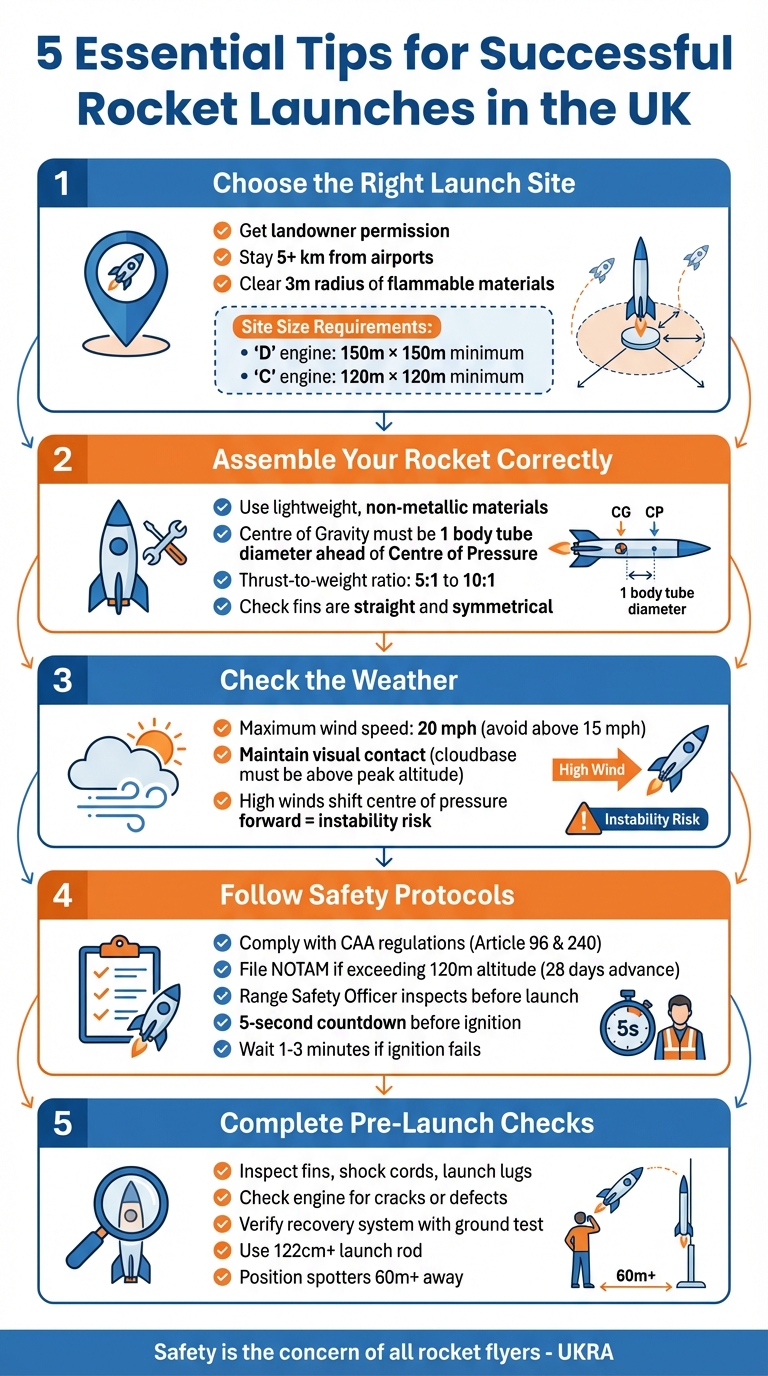
5 Essential Tips for Safe Rocket Launches in the UK
1. Choose the Right Launch Site
Safety and Compliance with Regulations
Picking the ideal launch site starts with understanding the rules. You must get clear permission from the landowner or occupier before launching. Launching on private property without consent is trespassing, and public spaces like parks are usually off-limits due to local byelaws and the difficulty of keeping people at a safe distance during a launch.
Your site must also be at least 5 kilometres away from any commercial airport or airfield. Use aviation charts to avoid controlled airspace, and if your rocket is expected to exceed 120 metres (400 feet), you’ll need to file a NOTAM (Notice to Air Missions). If your site is near coastal areas or large lakes where distress flares are used, make sure to get prior approval from the relevant authorities unless you’re at least 1 kilometre away.
Once the legal groundwork is done, the next step is finding a site that supports your rocket’s performance.
Improving Rocket Performance
The physical setup of your launch site plays a big role in how well your rocket performs. The area immediately surrounding your launch pad – at least 3 metres in all directions – should be free of flammable items like dry grass or crops. The launch pad itself needs to be on solid, stable ground. Lightweight pads on soft surfaces can shift or vibrate during ignition, which may cause ‘rod whip’ and throw off the rocket’s trajectory.
Keep an eye on wind speeds. Avoid launching in winds over 15 mph (around 24 km/h). If winds are above 10 mph (roughly 16 km/h), consider using motors with higher average thrust to counteract ‘weather-cocking’ – when the rocket veers into the wind. A longer, sturdier launch rod – about 120 cm (48 inches) – can also help the rocket reach a stable airspeed before it transitions to free flight.
Reducing Risks from External Factors
The size of your launch site should match the engine class of your rocket. For instance, rockets using a ‘D’ engine need a launch area of at least 500 feet by 500 feet (about 150 metres by 150 metres), while a ‘C’ engine requires a smaller area of around 400 feet by 400 feet (roughly 120 metres by 120 metres). Make sure the site is secure and keeps unauthorised people out. Steer clear of hazards like power lines, buildings, and trees. If your rocket gets caught in power lines, do not attempt to retrieve it.
It’s also smart to have some safety gear on hand. Bring fire extinguishers and a first aid kit to the site. A windsock can help you monitor wind direction, as conditions higher up may differ from those at ground level.
2. Assemble Your Rocket Correctly
Safety and Compliance with Regulations
When building your rocket, safety should be your top priority. Use materials that are lightweight and non-metallic, such as paper, cardboard, balsa wood, or plastic. Metal should only be used sparingly for structural purposes. Before every launch, a Range Safety Officer (RSO) will examine your rocket to confirm it can endure the forces of launch, aerodynamic pressures, and the impacts during recovery.
Once safety requirements are addressed, turn your attention to optimising the rocket's flight performance.
Optimisation of Rocket Performance
For a stable flight, ensure the Centre of Gravity (CG) is positioned at least one body tube diameter ahead of the Centre of Pressure (CP).
"The Rocket must be designed to be passively stable in all flight phases. Flyers must be able to demonstrate that the Centre of Pressure is a minimum of one body tube diameter behind the Centre of Gravity." - UKRA Safety Code
Choose a motor with an average thrust at least three times the weight of your rocket. Aim for a thrust-to-weight ratio between 5:1 and 10:1 to achieve the best results.
Thorough Inspection and Preparation
Even small mistakes can derail a successful launch. Check that your fins are straight and mounted symmetrically. Inspect the motor mount to ensure there is no debris or misalignment that could cause off-centre thrust [9, 13].
"All fins should be mounted straight on the body tube and in correct alignment. Even slight mistakes in these departments can cause a rocket to go off vertical." - JStarStar, Rocketry Forum
Examine all joints for strength, cracks, or signs of wear, especially if the rocket has been stored for a while [9, 13]. If you’re using electronic ejection systems or an untested recovery mechanism, always conduct a ground test before launch to confirm they work as intended.
Once you’re satisfied with the rocket's assembly and functionality, shift your focus to the recovery system.
Ensuring Reliable Recovery Systems
To protect your recovery device, insert flame-resistant recovery wadding between the motor and the recovery system. The recovery system should be packed loosely to ensure it ejects properly. Attach the launch lug securely to the body tube to maintain consistent contact with the guide rail [12, 14]. Fold your parachute or streamer loosely so it deploys effectively at the rocket's apogee. Lastly, ensure the launch rail is long enough for your rocket to reach stable aerodynamic speed before leaving the guide [9, 14].
3. Check the Weather Before Launch
Safety and Compliance with Regulations
Weather plays a critical role in determining whether your rocket launch can proceed safely and legally. According to the UK Rocketry Association (UKRA), rockets should never be flown in winds exceeding 20 mph. For most launches, it's recommended to keep wind speeds below 15 mph. Additionally, you must maintain visual contact with your rocket throughout its flight. This means the cloudbase must be high enough to track the rocket at its predicted peak altitude. If your rocket is likely to rise above the cloudbase, delay the launch to ensure visibility and airspace safety.
These weather factors directly influence your rocket's stability, which is crucial for a successful launch.
Minimising Risks from External Conditions
High winds can compromise your rocket's stability. For the fins to work effectively, the rocket must achieve stable flight before leaving the launch rod. In windy conditions, the flight angle may exceed 10 degrees as the rocket departs the rod, causing the centre of pressure to shift forward and increasing the risk of instability. Ian Voss, a seasoned rocketry expert, underscores the importance of safety:
"Safety is the key concern here. Rocketry has a very good safety record and enthusiasts would very much like to keep it that way".
To gauge wind speed on-site, you can use a simple test: drop a small piece of paper from a height of 2 metres. If it takes 2 seconds to land and drifts 2 metres laterally, the wind speed is roughly 1 metre per second. Always check local weather reports just before launch to spot any potential wind gusts or low cloud ceilings.
These stability concerns also extend to recovery, as explained below.
Ensuring Reliable Recovery Systems
Wind conditions significantly impact where your rocket will land. NASA's Glenn Research Centre highlights this challenge:
"Weather cocking makes it very hard to predict where your rocket will come down in high winds".
Parachutes and streamers are particularly vulnerable to drifting in strong winds, which could lead to your rocket landing in hazardous areas like power lines, trees, or motorways. If wind speeds exceed 10 mph, consider using a motor with higher initial thrust to help your rocket reach stable flight speed quickly. Another option is to use a longer launch rod, which gives the rocket more time to accelerate before encountering crosswinds.
4. Follow Safety Protocols
Safety and Compliance with Regulations
In the UK, all rocket launches must adhere to the Civil Aviation Authority's (CAA) Air Navigation Order (ANO). This includes Article 96 (Rockets) and Article 240 (Endangering safety of an aircraft), which emphasise the importance of avoiding risks to people, property, or aircraft. Before launching, ensure you have obtained the landowner’s consent.
Rockets are not allowed to enter controlled airspace without explicit permission from Air Traffic Control. Furthermore, launches are typically restricted within a 5-kilometre radius of commercial airports or airfields. If your rocket is expected to exceed an altitude of 120 metres (400 feet), you must submit a Notice to Airmen (NOTAM) to the CAA at least 28 days before the planned launch. These requirements highlight the need for careful preparation and strict adherence to regulations.
Thorough Inspection and Preparation
Meeting legal standards is just the beginning - detailed inspections play a key role in ensuring a safe launch. A Range Safety Officer (RSO) is responsible for overseeing the launch site and has the authority to delay or cancel launches if safety is compromised. The UKRA guidelines state:
"The RSO is expected to inspect each Rocket prior to launch and deny launch approval if he/she is not confident that the Rocket flight may be made safely."
Make sure all critical rocket components meet safety standards before presenting them for the RSO’s inspection.
Minimising Risks from External Conditions
To reduce fire hazards, clear a 3-metre radius around the launch pad of any flammable materials such as dry grass or crops. Your launch rail or rod should be positioned no more than 20 degrees from vertical to maintain a safe flight path. If the top of the launch rod is below eye level, use a cap or cup to prevent accidental eye injuries. These precautions, combined with thorough pre-launch checks, help manage potential risks.
Before ignition, provide a loud, five-second countdown. If the rocket fails to ignite, wait at least one minute for low-power rockets or three minutes for high-power rockets before approaching the launch pad. Always remove the safety key from the controller immediately. In cases where a rocket becomes stuck in power lines or other structures, never attempt to retrieve it. These steps are critical for ensuring safety throughout the launch process.
sbb-itb-f093e97
How To: Fly Safely
5. Complete Pre-Launch Checks
Before moving your meticulously assembled rocket to the launch pad, it’s vital to carry out final pre-launch checks. These steps help ensure safety and maximise performance.
Detailed Inspection and Preparation
Double-check that the fins, shock cords, and launch lugs are securely attached and properly aligned. Examine the solid engines for any signs of damage, such as cracks in the casing or defects in the nozzle, before installation.
When installing the engine, make sure it maintains the rocket’s Centre of Gravity ahead of the Centre of Pressure. This is a critical safety measure, as highlighted by NASA:
"You must always be aware of the people and things around you which can be harmed by your rocket, or which can harm you or your rocket."
Verifying Recovery Systems
To ensure a safe recovery, insert recovery wadding to shield the parachute from heat. Carefully fold the recovery system and place it loosely inside the body tube. If you’re using an unfamiliar ejection system, conduct a ground test first. Be mindful of the nose cone fit - if it’s too tight, the ejection charge might fail to deploy the parachute, potentially forcing the engine out instead.
Fine-Tuning Rocket Performance
For optimal launch conditions, use a launch rod that’s at least 122 centimetres (48 inches) long and stabilise the launch pad with weights or bungee cords to prevent movement during ignition. If it’s windy, consider using a motor with higher average thrust (like a B6 instead of a B4) and angle the launch rod slightly into the wind.
Before connecting the igniter clips, remove the safety key. Place spotters at least 60 metres away, ensuring the sun is behind them for better visibility during tracking. These checks help ensure all components work together seamlessly for a smooth and successful launch.
Conclusion
Every step in the pre-launch process builds on the safety measures we’ve covered. Careful preparation, adherence to safety protocols, and meeting regulatory requirements are key to a successful launch. As the UK Rocketry Association aptly puts it, "Safety is the concern of all rocket flyers".
Document each launch to refine your techniques and align with educational goals. Ensure you have the necessary permissions and insurance to steer clear of legal complications. For flights exceeding 120 metres, filing a NOTAM is essential. Using high-quality components ensures your rocket can handle the stresses of launch and land safely.
FAQs
What permissions are required to launch a model rocket in the UK?
To launch a model rocket in the UK, you’ll need to secure permission from the landowner and notify the Civil Aviation Authority (CAA) at least 28 days before the launch by completing their notification form. Additionally, the launch site must be located at least 8 kilometres (5 miles) away from any airfield.
If your rocket has a total impulse exceeding 10,240 Ns, you’ll need to obtain formal approval under Article 96 of the Air Navigation Order. Should your rocket have the capability to reach the stratosphere, you might also need a licence under the Space Industry Act 2018.
Make sure to follow all local regulations and prioritise safety throughout the entire launch process.
How do weather conditions impact a model rocket launch?
Weather is a key factor in achieving a safe and smooth rocket launch. Strong winds can destabilise a rocket or push it off course, while dense cloud cover can hide potential dangers and complicate tracking during the flight.
To reduce risks, rely on a trusted weather forecast before planning your launch. Steer clear of launching in windy conditions or when clouds are hanging low. Ideally, aim for clear skies and gentle breezes to ensure a steady and reliable ascent.
What safety measures should I follow for assembling and launching a model rocket?
To carry out a model rocket launch safely and successfully, it's essential to stick to the UKRA Model Rocket Safety Code. Start by building your rocket with lightweight, non-metallic materials such as paper, wood, or plastic. Make sure it is aerodynamically stable, structurally sound, and equipped with a dependable recovery system. Before launch, have the rocket inspected by a qualified Range Safety Officer (RSO) or a club officer to ensure everything is in order.
When it comes to motors, always use them exactly as the manufacturer intended - no modifications allowed. Igniters should only be installed at the launch pad once all non-essential personnel have moved to a safe distance. It’s also crucial to avoid including live animals, explosives, or any hazardous materials in the payload. If your rocket requires recovery wadding, ensure it’s flame-proof to minimise fire risks.
Before the big moment, run through a pre-flight checklist. Check that the rocket’s weight matches the motor’s limits, confirm the recovery system is securely packed, and ensure the launch rod or rail is stable and equipped with a blast deflector. A responsible adult or teacher must oversee all activities, and the RSO has the final say on whether the launch can proceed.
Safety on the ground is equally important. Set up a clear safety perimeter, keeping spectators at a safe distance, and have a plan in place to report any incidents or injuries immediately. By following these steps, you can enjoy a thrilling and secure launch experience.