
Best Adhesives for Model Rocket Construction
Choosing the right adhesive can make or break your model rocket. Here's a quick guide to what works best for different parts and materials:
- Yellow Wood Glue: Strong bonds for porous materials like wood and paper. Ideal for fins but avoid for high-stress areas like engine mounts. Sets in 30 minutes, fully cures in 24–48 hours.
- Cyanoacrylate (CA/Super Glue): Fast-setting (5–90 seconds), lightweight, and perfect for small, delicate parts. Not suitable for high-stress or vibration-prone areas due to brittleness.
- Epoxy: Best for high-stress components like engine mounts and fibreglass parts. Extremely strong but heavier and requires mixing. Curing time varies from 30 minutes to several hours.
- White PVA Glue: Beginner-friendly and works for low-power rockets made of cardboard or balsa wood. Weakest bond and slow drying but allows adjustments during assembly.
Quick Comparison
| Adhesive Type | Strength | Curing Time | Best For | Limitations |
|---|---|---|---|---|
| Yellow Wood Glue | Strong for porous materials | 24–48 hours | Fins, wood/paper assembly | Fast tack can hinder adjustments |
| Cyanoacrylate (CA) | Quick bond, lightweight | 8–24 hours | Small parts, detail work | Brittle, not for high-stress areas |
| Epoxy | Extremely strong | 30 min–4 hours | Engine mounts, high-stress areas | Heavy, requires precise mixing |
| White PVA Glue | Weak but flexible | 24 hours | Low-power rockets, beginners | Weak bond, unsuitable for high-stress |
Key Takeaway: Use yellow wood glue for most low-stress joints, epoxy for strength-critical areas, CA for quick fixes, and white PVA glue for beginner projects. Select based on material compatibility, weight, and stress levels to ensure safe and reliable launches.
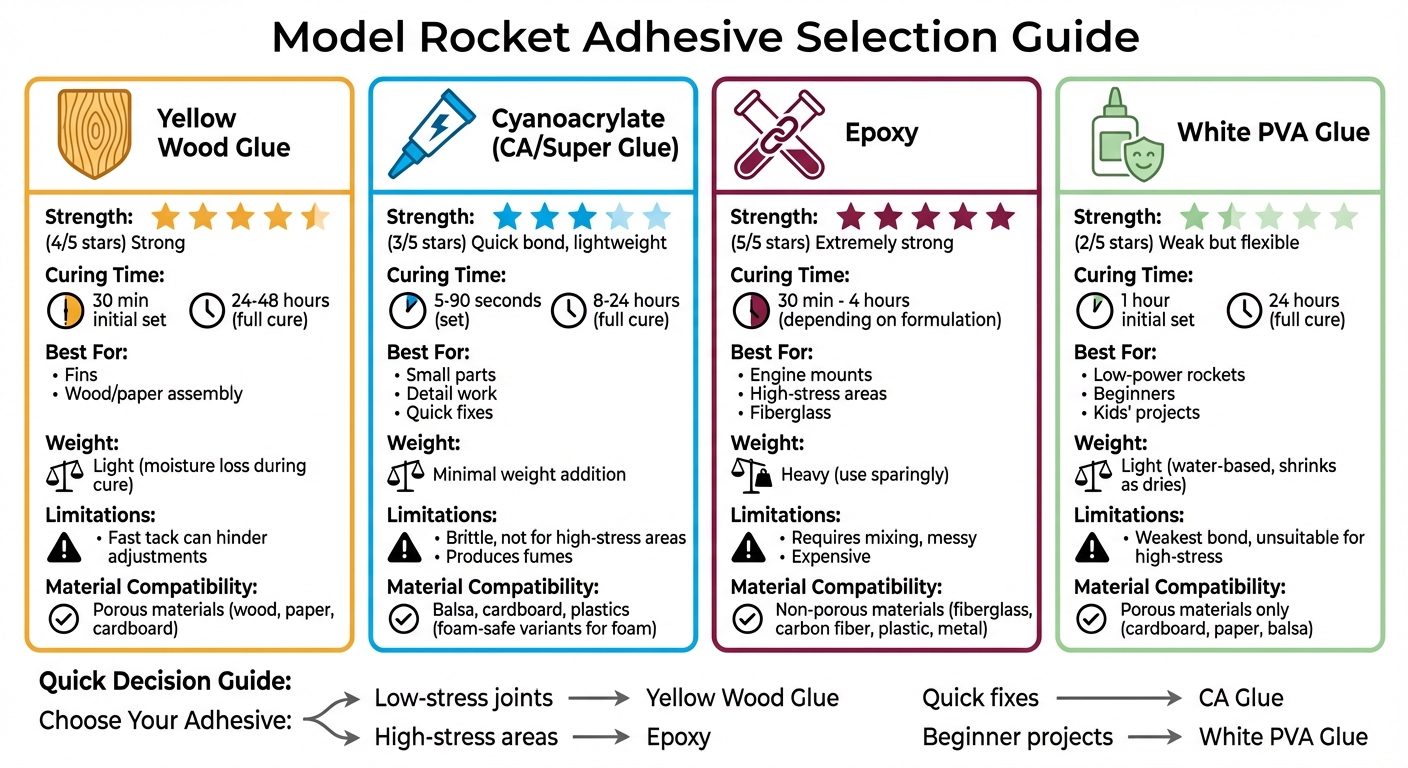
Model Rocket Adhesive Comparison Chart: Strength, Curing Time, and Best Applications
Adhesive & Glue for Rocket Building
sbb-itb-f093e97
1. Yellow Wood Glue (Aliphatic Resin Glue)
Yellow wood glue, also known as aliphatic resin glue, is a reliable choice for bonding balsa fins to cardboard body tubes. Its high solids content ensures bonds that are often stronger than the wood itself. Phil Woolfson, a Master Craftsman, highlights this strength:
Yellow glue is significantly stronger than the paper components.
Bond Strength
When it comes to bond strength, yellow glue performs exceptionally well for attaching fins. Its ability to penetrate the pores of wood and paper creates a robust mechanical bond. For the best results, pre-wet the wood surfaces to open the pores, allowing the adhesive to penetrate more deeply. Using the double glue joint method can further enhance the bond: apply a thin layer to each surface, wait about a minute until it becomes tacky, then apply a second layer before pressing the pieces together. However, for high-stress areas like engine mounts, epoxy may be a better option.
Curing Time
Yellow glue sets in approximately 30 minutes and reaches full strength within 24–48 hours. Its quick initial grab helps hold components in place during assembly. However, when working with tube couplers and transitions, exercise caution, as the fast tack can cause them to seize before they are fully seated.
Material Compatibility
This glue works best with porous materials such as balsa wood, basswood, cardboard, and paper. It is less effective on non-porous surfaces like plastic, fibreglass, or metal. For optimal adhesion on cardboard body tubes, lightly sand the glassine coating with 220 or 320-grit sandpaper, then clean the surface with a lint-free rag dampened with isopropanol to remove any dust.
Weight Impact
As yellow glue cures, it loses moisture, making it a lighter option compared to epoxy. However, applying too much glue at once can introduce excess moisture, which may warp paper body tubes. To avoid this, apply the glue in thin layers - up to five passes if needed - when creating fin fillets. This method ensures better control and reduces the risk of moisture damage.
Next, we’ll look at cyanoacrylate glue for situations where rapid bonding is required.
2. Cyanoacrylate (CA/Super Glue)
Cyanoacrylate, often referred to as CA or super glue, is the adhesive you turn to when speed is non-negotiable. It bonds surfaces in as little as 5 to 90 seconds, making it perfect for small, intricate parts that are tricky to clamp or hold in place.
Bond Strength
CA is particularly effective for surfaces with limited contact areas. As Stradawhovious from Flite Test explains:
A very small bit will adhere two surfaces together, so items with little surface area can be securely bonded.
Thin CA is especially useful because it wicks into tight joints through capillary action, creating a secure bond. It’s also great for joining different materials, like plastic to wood or carbon fibre to wood. However, its brittleness makes it less suitable for high-stress areas, such as motor mounts, where resistance to vibration and impact is crucial.
Curing Time
While CA sets in seconds, full curing takes between 8–24 hours. The rapid setting time means you need to position parts correctly on the first try - mistakes are hard to undo. As Airfield Models points out:
Cyanoacrylates also allow builders to make mistakes faster which are very difficult to correct. When this happens the time savings over the use of a slower adhesive are more than nullified.
For near-instant results, you can use chemical accelerators (often called kick-starters), but these are better suited for filling gaps rather than precision bonding.
Material Compatibility
CA works well with materials like balsa wood, cardboard, and various plastics [4, 11, 15]. Thin CA can penetrate wood grain to create strong joints and even harden threads cut into wood. However, it’s not all-purpose. Standard CA can dissolve foam, so foam-safe variants are essential for delicate materials [2, 12]. Also, avoid using CA on clear plastic canopies, as the curing fumes can cause fogging or crazing. For the strongest bond, ensure surfaces are clean and grease-free, as CA relies on a snug fit for maximum effectiveness.
Weight Impact
One of CA’s biggest advantages is that it adds almost no weight, making it ideal for detail work where every gramme matters. It’s also relatively affordable, with hobby-grade CA priced at around £4.00–£5.00 per ounce. To extend its shelf life, refrigerate opened bottles. Lastly, always work in a well-ventilated space - CA fumes can irritate your eyes and lungs.
Up next, we’ll look at epoxy, a better option for handling high-stress applications.
3. Epoxy
When it comes to handling high-stress components, epoxy stands out for its impressive strength and minimal curing shrinkage. It creates reliable bonds between fibreglass components and G‑10 phenolic materials while also being resistant to fuel and heat.
Bond Strength
Epoxy is widely recognised for its effectiveness in high-stress scenarios. Professional-grade options, such as Aeropoxy ES6209, can deliver up to five times the strength of hobby-grade adhesives when used with G‑10 materials. For plywood, epoxy often outperforms the wood itself. For example, tests revealed that plywood delaminated under forces ranging from 825 lbs (about 375 kg) to 2,071 lbs (approximately 940 kg) before the epoxy bond gave way. Drake Damerau from the Scranton Army Ammunition Plant noted:
The primary mode of failure in the plywood tests was delamination of the wood... the test results hinged on the strength of the wood. In every case, they broke at the joint and they all delaminated at the joint surface.
Epoxy can also be tailored to specific tasks. For instance, adding microballoons makes it ideal for creating fillets, while thinning it slightly for laminating fibreglass can be useful. However, thinning epoxy with acetone (e.g., by 5%) can reduce its bond strength by around 30%.
Curing Time
The curing process for epoxy varies depending on the formulation. A '15-minute epoxy' allows for 15 minutes of working time and typically takes 30–60 minutes to harden initially. For more demanding structural joints, such as motor mounts or firewalls, slow-cure epoxies are the better choice. These types offer working times ranging from 30 minutes to 4 hours, enabling deeper penetration into porous materials like wood and resulting in tougher, less brittle bonds. Avoid using 5-minute epoxy for load-bearing repairs - it tends to be weaker, grows brittle over time, and may not cure adequately for long-term durability.
Material Compatibility
Epoxy excels with non-porous materials, where other adhesives often fall short. It's the go-to choice for bonding fibreglass, carbon fibre, plastic, and metal to wood. When working with cardboard body tubes, epoxy is particularly useful for sliding couplers into place, as it doesn’t cause the swelling associated with water-based glues. For best results, roughen surfaces (e.g., using 60-grit sandpaper) before bonding G‑10 or fibreglass parts. Laminating plywood with 6‑oz fibreglass cloth can also significantly enhance its strength. These qualities make epoxy a top pick for high-stress applications where durability outweighs concerns about added weight.
Weight Impact
Epoxy is heavier than alternatives like wood glue or CA, so it’s best used sparingly and only where strength is a priority. Excessive use - especially in fillets - can throw off balance. To reduce weight without sacrificing strength, you can mix epoxy with microballoons (phenolic microspheres) to create a lighter, sandable material for fillets. Always ensure proper ventilation while working with epoxy, as its fumes can irritate both skin and lungs.
Next, we’ll dive into white PVA glue and explore when it might be the right choice for your rocket builds.
4. White PVA Glue
White PVA glue stands out as a beginner-friendly option, especially when compared to more specialised adhesives. It's one of the most commonly used glues for building model rockets and is known for being non-toxic, water-soluble, and drying clear. These features make it a great starting point for newcomers to rocketry. That said, its strength and compatibility with materials are somewhat limited compared to other adhesives.
Bond Strength
When it comes to bonding, white PVA glue performs well with low-power rockets made from porous materials like cardboard, paper, and balsa wood. However, its bond strength is weaker than yellow wood glue, which makes it unsuitable for high-stress components like motor mounts or rockets designed for high-power flights. Still, its moderate strength is often enough for simpler builds, and its forgiving curing process can be helpful for beginners.
Curing Time
White PVA glue takes about an hour to set and requires a full 24 hours to cure completely. This longer setting time allows for adjustments, which is handy when aligning parts or sliding couplers into body tubes. However, to ensure a strong bond, it's important to keep components clamped until the glue has fully cured. This extra flexibility during assembly is one of its key advantages.
Material Compatibility
This glue works best with porous materials such as cardboard, paper, and balsa wood. However, it struggles to adhere to non-porous surfaces like plastic or metal. Additionally, it’s neither water-resistant nor fuel-proof, meaning it can degrade when exposed to moisture or certain fuels. Be cautious when using it on thin paper or textured sheets, as the glue's water content can sometimes cause wrinkling or warping.
Weight Impact
Because it’s water-based, white PVA glue shrinks as it dries, which helps keep it lightweight - an advantage for low-power rockets. However, this shrinkage can occasionally result in uneven surfaces, so careful application is necessary to avoid imperfections.
Advantages and Disadvantages
Different adhesives come with their own set of strengths and limitations. The table below summarises the performance features and ideal uses of four common adhesive types:
| Adhesive Type | Key Advantages | Key Disadvantages | Best For |
|---|---|---|---|
| Yellow Wood Glue | Stronger than white glue, sandable, affordable, easy water cleanup | Can "grab" too quickly for sliding parts, may warp tubes | Wood fins, general wood/paper assembly |
| Cyanoacrylate (CA) | Instant setting, waterproof, hardens wood grain | Brittle, produces fumes, costly, dissolves foam, tough to sand | Hardening tube ends, tacking parts, balsa |
| Epoxy | Extremely strong, fills gaps, heat/fuel resistant, no shrinkage | Heavy, expensive, requires mixing, messy, hard to sand | Engine mounts, high-power fins, fibreglass |
| White PVA Glue | Non-toxic, dries clear, flexible, allows more adjustment time | Weakest bond, high shrinkage, slow drying, unsuitable for plastic/metal | Lightweight paper, kids' projects |
When selecting an adhesive, factors like weight, sandability, material compatibility, and durability come into play. For instance, epoxy provides exceptional strength but adds significant weight. Yellow wood glue delivers a smooth, sandable finish, while CA glue's brittleness and white glue's tendency to shrink limit their use in high-stress areas. For sliding couplers into body tubes, white glue or epoxy are better options, as wood glue can "grab" too quickly, making adjustments difficult. Additionally, water-based glues like white and yellow glue shrink as they dry, which may cause body tube warping, whereas epoxy and CA maintain their original volume.
Durability is another critical consideration, especially for long-term projects such as building a complex kit. Over time, CA glue can become brittle when exposed to oxygen, with some modellers reporting joints breaking down into a white, powdery residue on older models. It also dissolves when exposed to nitro methane, making it unsuitable for rockets using high-nitro fuels.
Ultimately, the choice of adhesive depends on the specific requirements of your project, balancing factors like strength, working time, and material compatibility.
Conclusion
Picking the right adhesive is a key step in ensuring your model rocket's safety and durability. For low-power rockets built with materials like cardboard, paper, and balsa wood, yellow wood glue is an excellent choice. It provides strong, sandable bonds. If you need extra time to adjust parts, white PVA glue is a reliable alternative. These adhesives form a solid foundation for handling the greater stresses found in high-power rockets.
When it comes to high-power rockets, strength becomes the priority. Slow-cure epoxies are ideal for critical components like motor mounts, fin attachments, and other load-bearing joints. In fact, professional-grade epoxies can offer up to five times the required strength for these applications. This added durability is crucial for preventing failures during high-stress launches. For quicker tasks that don’t bear heavy loads, consider using CA glue or fast-setting epoxies.
That said, adhesives like 5-minute epoxy and cyanoacrylate (CA) should only be used for non-structural purposes, such as tacking parts together or hardening the ends of tubes. As highlighted by The Model Rocket:
Super glue will destroy your design and crumble it in a matter of years... it will grow weak when exposed to oxygen, causing components to break off more easily.
CA glue can degrade over time due to oxygen exposure, so it should never be relied upon for primary structural bonds.
For a secure and lasting connection, use a small amount of CA to hold parts temporarily in place, then reinforce the joint with slow-cure epoxy. To maximise adhesion, especially on materials like phenolic or fibreglass, always prepare the surface properly. This includes scuffing it with 60-grit sandpaper and cleaning it with alcohol.
Choosing the right adhesive for each material and stress level is critical to maintaining your rocket's structural integrity. Using wood glue on plastic or relying on CA for high-stress joints can lead to failure. By selecting the correct adhesive for every component, your rocket will be ready to handle multiple launches with confidence.
FAQs
What is the best glue for attaching fins to a model rocket?
When it comes to attaching fins to a model rocket, thin cyanoacrylate (CA) glue is a top choice. It sets quickly and creates a strong bond, especially with non-porous materials like plastic or fibreglass. If your fins are made of wood, such as balsa, PVA wood glue works just as well, providing a solid and dependable hold.
Before applying any adhesive, make sure the surfaces are clean and dry to maximise the bond's strength. Use only a small amount of glue - this helps keep the rocket lightweight and ensures a tidy finish. Once applied, give the glue enough time to cure fully before handling, so the bond is strong enough to handle the forces of a launch.
Can I use cyanoacrylate glue (super glue) for high-stress parts of a model rocket?
Cyanoacrylate glue, often referred to as super glue, is best suited for smaller, non-load-bearing parts of a model rocket. While it sets quickly and is convenient for minor components, it has a tendency to become brittle over time. This makes it a less dependable option for areas that endure high stress, like fins or engine mounts.
For these critical parts, epoxy or wood glue is a much better choice. These adhesives create stronger, more resilient bonds that can handle the intense forces rockets face during launch and flight. Always match your adhesive to the materials you're working with to ensure both safety and optimal performance.
What’s the best way to ensure a strong bond when using epoxy for building model rockets?
To create a reliable bond with epoxy, start by preparing the surfaces properly. Use fine sandpaper, such as 220 grit, to lightly scuff the areas you plan to join. This helps the epoxy adhere better. Make sure both surfaces are completely clean - free from dust, grease, or any other contaminants that could interfere with bonding.
When mixing the epoxy, follow the manufacturer’s instructions carefully to get the correct ratio. An incorrect mix can compromise the bond's strength. Once mixed, apply a thin, even layer of epoxy to both surfaces. Ensure complete coverage, but avoid overdoing it, as excess epoxy can create a mess without adding strength.
Press the parts together firmly and, if possible, secure them with clamps or tape to hold everything steady while the epoxy cures. Be patient and allow the epoxy to cure for the time recommended on the product label - this is crucial for achieving maximum strength. For critical components like fins or engine mounts, it's best to use a high-strength epoxy specifically designed for model construction to ensure both durability and safety.