
Rocket Motor Storage Checklist
If I had to boil this down to one rule, it’s this: keep rocket motors cool, dry, locked away, and check them before and after every session.
This checklist is about six things that matter most in the UK: where I store motors, how I package them, what labels I keep visible, how I track stock, how I watch for damp and heat, and how I pack only the motors I need for launch day. It also separates storage at home or school from short trips to a launch site, because those are not the same thing.
Here’s the short version:
- Store indoors, not in a shed, loft, or garage
- Keep motors away from heat, direct sun, damp, and flammable items
- Lock them up and limit access to a named adult
- Leave them in original packaging where possible, with labels easy to read
- Store igniters apart from motors unless still sealed by the maker
- Keep a stock log with dates, motor codes, counts, and notes
- Check for damage like cracks, swelling, loose nozzles, corrosion, or odd smells
- Aim for about 20°C, and avoid places below 0°C or above 60°C
- Take only what you need to the launch and use a rigid, dry box
- Check unused motors again when you get back, then update the log at once
A few details stand out. Moisture can lead to ignition failure. Heat in a parked car can damage motors. And a motor dropped on a hard floor may no longer be safe to use, even if the outside looks fine. For schools, I’d also expect adult control, site rules, and a written risk assessment every time.
That’s the whole system in one view: safe place, clear labels, simple records, dry conditions, and careful transport.
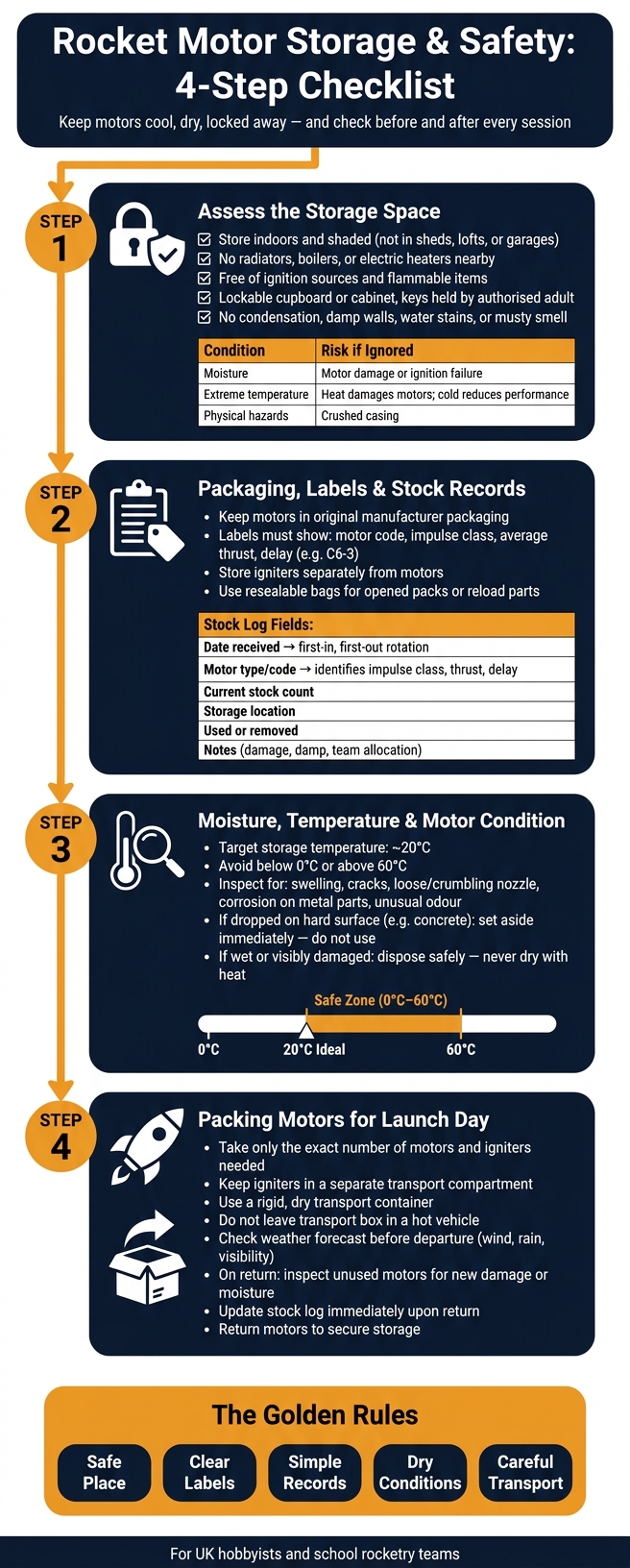
Rocket Motor Storage & Safety Checklist: 4-Step System
How to Store and Transport Model Rocket Kits
sbb-itb-f093e97
Checklist 1: Assess the storage space
Use this check before storing motors for the long term.
Look at the storage space before you put any motors in it. A quick check now can save hassle later.
Location, heat sources, and ignition risks
The space should be indoors and away from anything that gives off heat or might cause ignition. Avoid sheds, lofts, and garages. They’re rarely stable enough.
Check each point before storing motors there:
- ☐ Indoors and shaded
- ☐ No radiators, boilers, or electric heaters nearby
- ☐ Keep the area free of ignition sources and flammables
Security and access control
Store motors in a lockable cupboard or cabinet, with keys held by an authorised adult.
In schools, use the approved storage location and follow site risk assessment rules.
Clean, dry, and stable conditions
Check the space for condensation on walls, water stains, or a musty smell. Any of these can point to moisture. Temperature matters as well. An internal room or cupboard will usually stay more even than a garage, shed, or loft.
| Condition | What to look for | Risk if ignored |
|---|---|---|
| Moisture | Damp walls, condensation, water stains | Motor damage or ignition failure |
| Temperature | Avoid sheds, lofts, garages | Heat can damage motors; cold can reduce performance |
| Physical hazards | Heavy items above, cluttered shelving | Crushed casing |
Keep motors away from heavy boxes and loose tools.
Next, check packaging, labels, and stock records before storing anything away.
Checklist 2: Packaging, labels, and stock records
Once the storage space is approved, the next job is simple: keep each motor easy to identify and safe from damage. The container matters just as much as the cupboard.
Keep motors in good packaging with readable labels
Keep motors in their original manufacturer packaging where you can. If the packaging is oil-stained, wet, torn, or crushed, take that as a warning sign.
Labels need to stay clear and easy to read. They must show the motor code, impulse class, average thrust, and delay. For example, C6-3 shows the impulse class, average thrust, and delay. That label should also match your stock log.
If you store motors upright, mark the top end of each tube so you can spot the right one at a glance.
For opened packs or reload parts, use resealable bags. It’s a simple fix, but it helps keep everything together and guards against moisture.
Store igniters separately from motors
Store igniters away from motors unless they are still sealed in the original pack. Use a separate compartment or a clearly labelled container.
Keep a simple stock log
A spreadsheet works well if you want to sort and filter. A notebook is fine if you want to keep things manual. Either way, log every movement so you know what’s in storage, what’s been used, and what may need disposal.
Record the date received too. That lets you use a first-in, first-out approach, so older motors are used before newer ones.
| Field | Purpose |
|---|---|
| Date received | Tracks stock age for first-in, first-out rotation |
| Motor type/code | Identifies impulse class, thrust, and delay |
| Current stock | Count before and after sessions |
| Storage location | Shows which box, bin, or locker holds the item |
| Used or removed | Records use or disposal after each session |
| Notes | For damage, damp, or team allocation |
For school teams, add a column for class set or team box assignment.
Next, check moisture, temperature, and motor condition.
Checklist 3: Moisture, temperature, and motor condition
After you've logged your stock of rocket motor engines, check where the motors are stored and inspect the motors themselves before every session.
Check for damp and temperature extremes
Try to keep storage close to 20°C. Avoid places that drop below 0°C or climb above 60°C. Big temperature swings over time can harm the propellant and lead to ignition failure.
Give the storage area a quick once-over for condensation, damp patches, or a musty smell. If you spot condensation inside a sealed bag, that's a clear sign moisture has reached the stock.
Inspect motors for visible damage
Next, inspect each motor before it gets anywhere near the launch kit.
Before any session, check for swelling, cracks, a loose or crumbling nozzle, corrosion on metal parts, or an unusual odour.
If a motor shows any of these signs, or if it has been dropped on to a hard surface such as a concrete floor, set it aside at once and don't use it. Impact can cause internal damage that you won't see from the outside, but it can still lead to failure at ignition. If a motor is wet or visibly damaged, dispose of it using safe disposal guidance. Never try to dry it out or warm it with heat.
Checklist 4: Packing motors for launch day
Once the condition checks are done, pack only what you need for the launch. Transport is your last chance to avoid damage, moisture, and simple mix-ups. Taking too much gear, or skipping the return log, can create risk that’s easy to avoid.
Take only what the session needs
Work out the exact number of motors and igniters needed for the session, then take just that amount. Leave the rest locked away in your main storage. That keeps the quantity in transport low and makes counting far easier at both ends of the day.
Keep igniters in a separate transport compartment. It’s a small step, but it helps prevent confusion when you’re setting up on site.
Use a sturdy, dry transport container
Use a rigid, dry transport container. It helps stop crushing, movement, and damp getting to the motors.
Don’t leave the transport box sitting in a hot vehicle for long. High temperatures can affect burn rate and pressure, which creates a safety risk.
It also helps to check the forecast before you set off. Wind, rain, and poor visibility can all affect whether the session can go ahead. UK club launches often set launch limits for wind, rain, and visibility.
Check and log unused stock after the launch
The trip back counts too. Treat it as part of the handling check, not an afterthought.
When you return, inspect any unused motors before putting them back into storage. Look for new damage or any sign of moisture picked up during transport or while on site. Make sure labels are still easy to read.
If a motor was dropped or got wet during the session, set it aside and deal with it under safe disposal guidance. Don’t put it back into general stock.
Once that’s done, return the motors to secure storage and update the stock log straight away.
Conclusion: A short storage routine to repeat every time
Motor storage should be simple and easy to repeat. Use the same routine each time: check the storage space, check the stock, take only what you need, and update the log when you return it.
Hobbyists and teachers follow the same routine. Doing it the same way each time helps keep storage checks reliable.
FAQs
How often should I inspect stored rocket motors?
Inspect stored rocket motors often. There’s no set timetable, but regular visual checks make it easier to spot signs of wear before they turn into a bigger problem.
Look over the seals, nozzles and casings for any damage, including discolouration, swelling, powdery residue, cracks or dampness. Then check them again immediately before use.
If you notice physical damage, dispose of the motors properly.
What should I do with a dropped motor?
Treat a dropped rocket motor as if something may have gone wrong inside, especially if it struck a hard surface like concrete.
Before you use it, check the casing for cracks, swelling, discolouration, or any powdery residue. If you spot any sign of damage, do not use it. Physical damage can lead to misfires or uneven combustion.
Can I keep rocket motors in a car overnight?
No. Don’t keep rocket motors in a car overnight.
A car can swing from cold to hot far more than most people expect, especially if it’s parked outside or left in the sun. Those temperature shifts can upset the propellant, harm the motor casing, or change how the motor performs.
Move the motors to a cool, dry, well-ventilated indoor space as soon as you get back.