
How to Calculate Parachute Descent Rate
If I want to check whether a rocket will land too hard or drift too far, I use one number: descent rate. For most hobby and school rockets, about 5–6 m/s is a common target, though some setups may sit closer to 5–9 m/s depending on mass, field size and landing toughness.
In simple terms, I work it out from:
- landing mass of the rocket
- parachute area
- gravity: 9.81 m/s²
- air density: 1.225 kg/m³ at sea level
- drag coefficient: often 0.55 to 0.80
The key formula is:
v = √((2mg) / (ρC_dA))
That means:
- a heavier rocket comes down faster
- a larger parachute comes down slower
- a spill hole cuts area, so descent rate goes up
- a poor unit conversion can spoil the whole answer
A quick example: a 0.5 kg rocket on a 0.5 m parachute with C_d = 0.8 comes down at about 7.1 m/s, which is a bit above the usual 5–6 m/s band.
I’d keep these points in mind before flight:
- use post-burn mass, not lift-off mass
- measure chute diameter flat
- convert g to kg and cm to m
- check maker data for C_d and how diameter is defined
- compare the result with wind and field size
- after flight, use timing or altimeter data to adjust the estimate
Parachute Physics
sbb-itb-f093e97
Quick comparison
| Factor | If it goes up | Effect on descent rate |
|---|---|---|
| Rocket mass | Higher | Faster landing |
| Parachute diameter | Higher | Slower landing |
| Canopy area | Higher | Slower landing |
| Drag coefficient | Higher | Slower landing |
| Spill hole size | Higher | Faster landing |
| Air density | Higher | Slower landing |
Bottom line: I’d use the formula as a first check, then match the result to the rocket, the field and the day’s wind.
The formula and the values you need
The standard formula is:
v = √((2mg) / (ρC_dA))
Each part of the formula uses a value you either measure or estimate. In the next section, you’ll use them to work out descent rate step by step.
Mass, gravity, air density and drag coefficient
Mass (m) is the rocket’s landing mass in kilograms. That means the airframe, recovery gear and the spent motor casing. Use the post-flight mass, not the lift-off mass, because the propellant has already burned away.
Gravity (g) is a fixed constant: 9.81 m/s².
Air density (ρ) tells you how dense the air is. For sea level, use 1.225 kg/m³.
Drag coefficient (C_d) is a dimensionless number that shows how well the canopy catches air. A typical range is 0.55–0.80, depending on the canopy shape.
Calculating canopy area from parachute diameter
Work out canopy area (A) from the parachute’s nominal diameter, measured flat.
The formula is: A = π × (D ÷ 2)²
For example, a 1 m diameter canopy has an area of 0.785 m².
If the parachute has a centre spill hole, subtract that area from A. A spill hole can help with stability in flight, but it also cuts the drag area, which means the descent rate goes up.
Once you know the mass and canopy area, you can plug the values into the formula.
| Term | Symbol | Unit | Typical Value |
|---|---|---|---|
| Descent rate (terminal velocity) | v | m/s | Calculated result |
| Rocket mass (landing) | m | kg | Measured (include spent motor and recovery gear) |
| Gravity | g | m/s² | 9.81 |
| Air density | ρ | kg/m³ | 1.225 (sea level) |
| Drag coefficient | C_d | Dimensionless | 0.55–0.80 (typical) |
| Canopy area | A | m² | Calculated: π × (D/2)² |
How to calculate parachute descent rate step by step
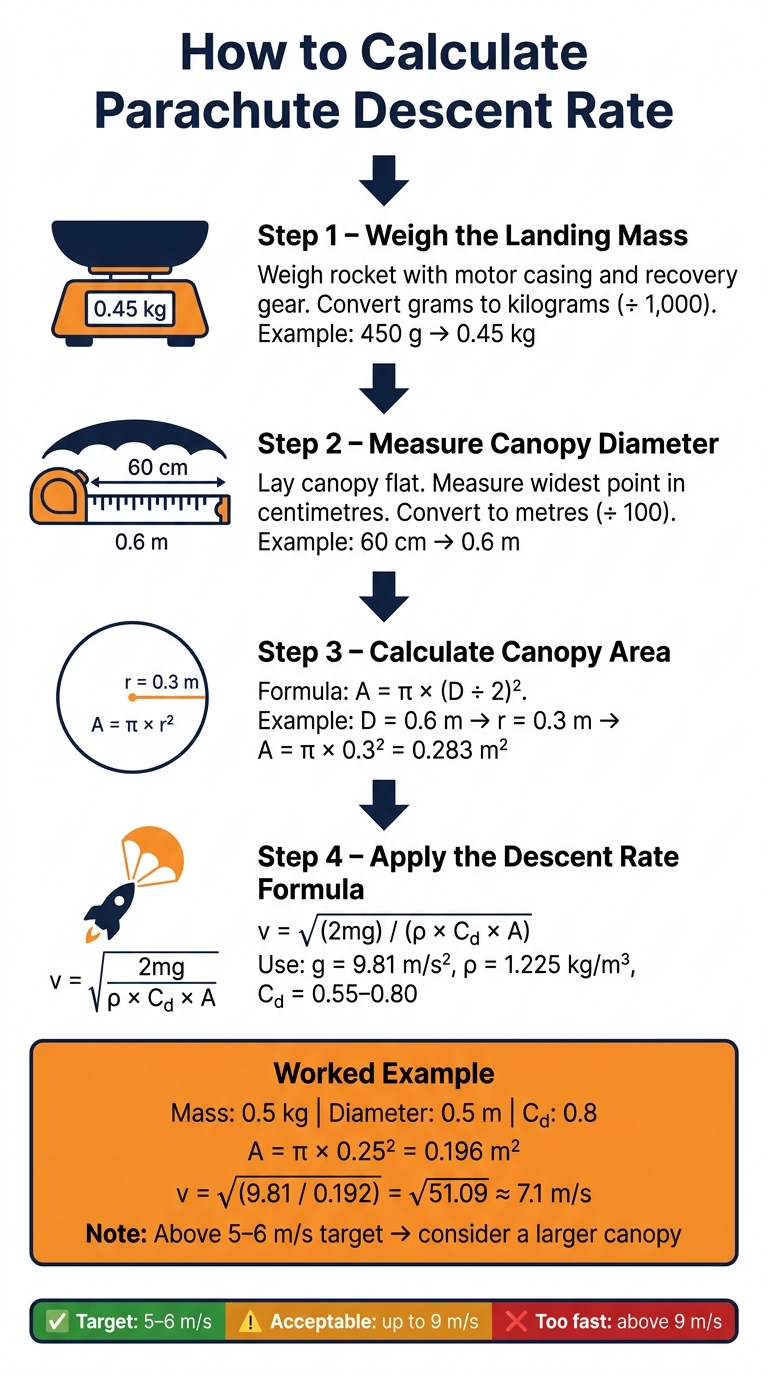
How to Calculate Parachute Descent Rate: 4-Step Formula Guide
Use the measured mass and parachute area in the formula to work out descent rate in four simple steps.
Steps 1 to 4: measure, convert and calculate area
- Weigh the landing mass
Start with the rocket’s landing mass and parachute size, then work out the area. Weigh the rocket with the motor casing and recovery gear fitted. Write the reading down in grams, then divide by 1,000 to convert it to kilograms. So 450 g becomes 0.45 kg.
- Measure the canopy diameter flat across its widest point
Lay the canopy on a flat surface and measure straight across in centimetres. Then divide by 100 to convert it to metres. A canopy that measures 60 cm becomes 0.6 m.
- Calculate canopy area
Divide the diameter by two to get the radius, then use A = π × r². For a 0.6 m diameter canopy, the radius is 0.3 m, so:
A = π × 0.3² = 0.283 m²
- Insert your measured values and chosen drag coefficient into the formula
Pick a C_d from the range given above, then place it into v = √((2mg) / (ρC_dA)). At that point, you’ve got everything you need to run a full calculation.
Worked example in metric units
Take a small school rocket with a recovery mass of 0.5 kg and a parachute diameter of 50 cm (0.5 m). The canopy area is:
π × (0.25)² = 0.196 m²
Using C_d = 0.8:
v = √((2 × 0.5 × 9.81) / (1.225 × 0.8 × 0.196)) = √(9.81 / 0.192) = √(51.09) = ≈ 7.1 m/s
That’s above the 5–6 m/s target. In plain terms, the rocket is coming down a bit too fast, so a larger canopy would slow the landing.
Checking your result with an online calculator
Once you’ve worked it out by hand, put the same numbers into a calculator to double-check it. Enter the mass in kilograms, the diameter in metres, plus C_d and air density.
If the answer comes out noticeably different, the usual culprit is a unit conversion slip. Most often, that means grams were not converted to kilograms, or centimetres were left as centimetres instead of metres.
Adjusting parachute size for safer recovery and less drift
Once you know the descent rate, you can use it to work out if the canopy should be larger or smaller. A larger canopy adds area, creates more drag, and slows the rocket down. A smaller canopy does the opposite: it brings the rocket down faster, keeps it in the air for less time, and cuts drift.
On smaller flying fields, drift can matter more than landing speed. That’s why the descent-rate figure isn’t just a maths result. It helps you decide whether the canopy area should go up or down.
How diameter and canopy design affect descent rate
Diameter has the biggest effect on descent rate. Canopy shape and spill holes also change drag, but diameter usually has more impact. It’s worth checking the manufacturer's descent-rate data against your own calculation, just to see if the numbers line up.
Comparison table: rocket mass, parachute size and descent rate
These examples show how changing canopy size affects landing speed and drift risk.
| Rocket Scenario | Mass | Canopy Diameter | Assumed C_d | Descent Rate | Outcome |
|---|---|---|---|---|---|
| Light classroom rocket | 0.25 kg | 38 cm flat sheet | 0.75 | ~5.5 m/s | Soft landing |
| Medium hobby rocket | 0.6 kg | 61 cm canopy | 0.8 | 7.0–7.8 m/s | Acceptable |
| Heavy educational project | 2.0 kg | 106 cm canopy | ~0.75–0.8 | 6.8 m/s | Acceptable, firmer landing |
| Heavy educational project | 2.0 kg | 122 cm canopy | ~0.75–0.8 | 6.0 m/s | Soft landing, greater drift risk |
Use the size of the field and the forecast wind to judge which result makes sense. For the 2.0 kg rocket, moving from a 106 cm canopy to a 122 cm canopy cuts the ground impact speed from about 6.8 m/s to 6.0 m/s. That’s a clear improvement. But if the wind is up and recovery space is tight, the extra drift from the larger chute may make it the worse choice on the day.
Applying the method with Rocketry for Schools kits
Rocketry for Schools kits use the same formula. The only things that change are the mass and the parachute measurements.
With these kits, your main inputs are simple: the rocket’s measured mass and the chute that comes with the kit.
Weigh the rocket in its recovery-ready state, or use the launch mass minus the propellant mass listed for the motor. That means including the airframe, recovery system, any onboard payload, and a spent casing of the same motor type.
Next, measure the supplied parachute flat across its widest point. Then use that diameter in the area formula. If the chute is not a standard round canopy, adjust C_d to match. A target descent rate of 5–9 m/s is a reasonable range for most educational launches. If your result sits outside that range, change the parachute size before flight day.
Then compare the result with your field size and the wind forecast. If the rocket looks likely to drift too far, use a smaller canopy for that flight.
Using flight data to refine your estimate
After the first flight, check the descent profile if your kit has onboard electronics such as an altimeter. Compare that data with your calculation. If the two don’t line up well, revisit the C_d value in your next calculation. Real-world performance depends on the canopy profile, so a small tweak here can bring your estimate closer to what the rocket actually does.
No electronics? You can still learn a lot. Timing the descent from apogee to touchdown can show whether the recovery system is broadly on track.
Use these measurements in the final checklist before flight.
Final checklist and key points
Once you've run the formula, do a quick sense-check before you trust the number. Small input errors can throw the result off, so check the landing mass, parachute diameter, canopy area and chute-specific C_d first.
One point matters more than many people think: C_d is not a fixed value you can lift from a generic chart. And nominal parachute size isn't always the same as the measured working size. So don't lean on a generic default. Use the manufacturer's C_d and the way that maker defines diameter.
For descent rate, aim for 5-6 m/s. If your result lands outside that band, change the parachute diameter before launch.
After you've done the maths, check it in flight. Treat the first result as provisional. Once the first flight is done, compare the altimeter data with your estimate and then tune C_d in your simulation.
FAQs
How accurate is the formula in real flights?
Calculated descent rates are estimates, not exact predictions. The reason is simple: a model rocket parachute’s drag coefficient doesn’t stay fixed.
It can change based on canopy loading, the parachute’s material, and small construction details. On top of that, manufacturers don’t always measure parachutes in the same way, which can muddy the waters even more.
So in actual flights, treat the formula as a rough guide, not gospel. If you want to know how your own recovery setup behaves, practical drop tests are the best way to check its performance.
What descent rate is safest for my rocket?
The safest descent rate is one that gives you a gentle, stable landing and helps limit damage on impact. If you're new to this, a common rule of thumb is 3.5 m/s for a slow, gentle descent.
Go much faster, and the landing gets harsher. At 4.5 m/s, for example, impact is noticeably harder. The aim is to pick a parachute size that gets you to your target speed while keeping the descent vertical and stable.
How do I allow for wind and drift?
To allow for wind and drift, use: (Altitude / Descent Rate) × Wind Speed = Drift Distance.
Start by dividing the apogee altitude by the descent rate to work out the total descent time. Then multiply that figure by the wind speed to estimate how far the rocket may drift from the launch pad.
To cut drift, angle the launch rod slightly into the wind. Just don’t overdo it - too much angling can create safety issues.