
Model Rocket Safety Code Explained
If I had to boil the UK model rocket safety code down to one line, it would be this: fly only in the right place, in the right weather, with the right kit, and stop at once if anything looks wrong.
If you launch in the UK, I need to follow the same core rules every time: get landowner permission, stay well clear of airfields, power lines, roads, railways, people and livestock, use certified motors, launch electrically, and never fly in strong wind or poor visibility. One clear number stands out: do not launch if wind is above 20 mph.
Here’s the short version:
- Site: large open space, away from hazards and restricted airspace
- Permission: no launch without the landowner’s say-so
- Weather: no high wind, storms, poor visibility, heavy cloud, or night flying
- Rocket build: lightweight materials, no metal nose cones, body tubes, or fins
- Motors: only certified commercial motors; no tampering
- Recovery: parachute or streamer packed properly with flame-resistant wadding
- Launch method: electrical controller with a safety key/interlock
- Countdown and misfires: loud countdown; if it misfires, wait, disarm, then inspect
- Hard no’s: no explosive or flammable payloads, no live animals, no flights at targets, aircraft, or into cloud
The main point is simple: the code is there to cut the risk of fire, injury, and out-of-control flights before the rocket ever leaves the pad. In the UK, it also matters for club and insurance rules, so I’d treat it as a must-do checklist, not a nice extra.
| Area | What I need to remember |
|---|---|
| Launch site | Open ground, far from buildings, trees, power lines, roads, railways, airfields |
| Weather | Keep below 20 mph wind; no storms, poor visibility, heavy cloud, or night launches |
| Rocket and motor | Lightweight rocket, certified motor, no motor changes, no major metal parts |
| Recovery and launch | Pack recovery gear well, use wadding, launch electrically, follow misfire steps |
Below, I’d walk through these rules in plain English so it’s easy to check before each launch.
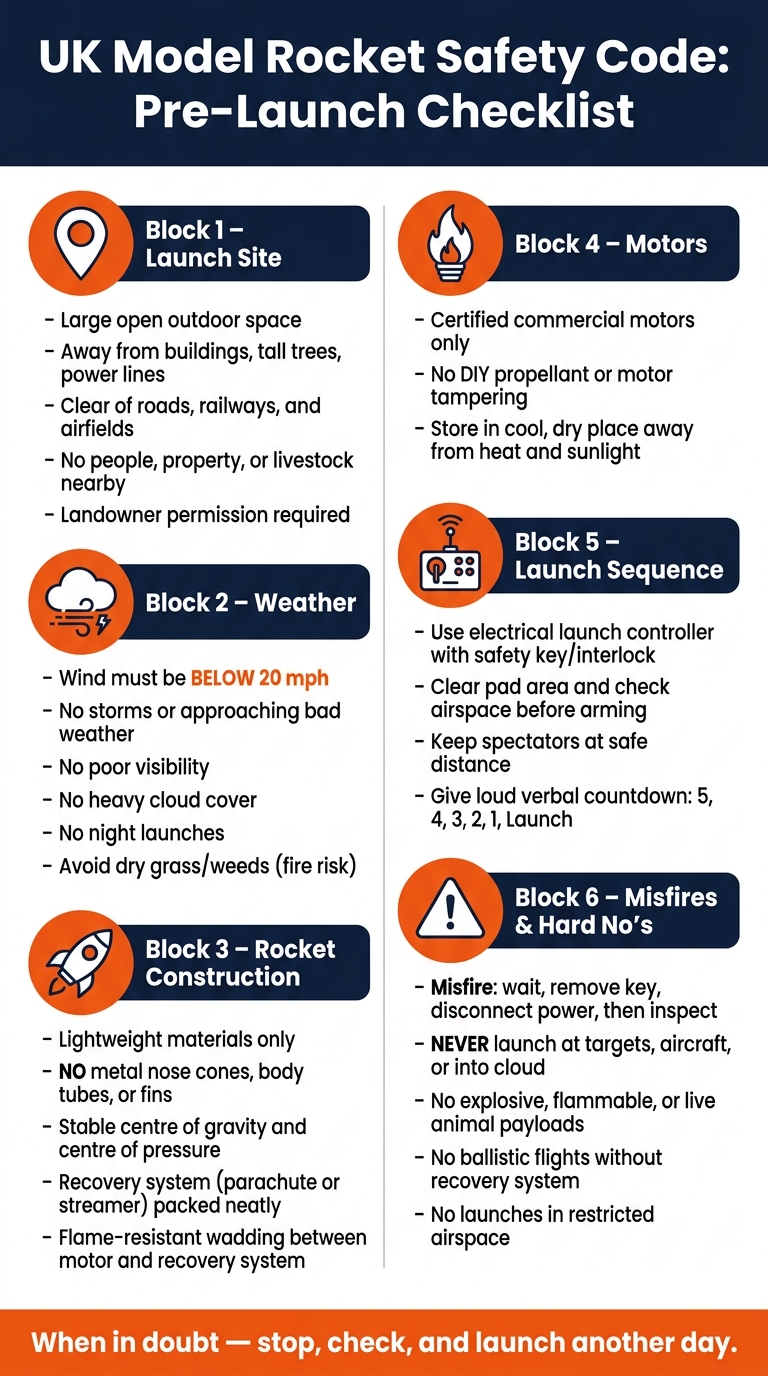
UK Model Rocket Safety Code: Pre-Launch Checklist
How To: Fly Safely
sbb-itb-f093e97
Where and when can you safely launch a model rocket?
Picking the right place and the right weather matters. If either one is off, the launch isn't safe.
What counts as a suitable launch site
Use a large, open outdoor space well away from buildings, tall trees, overhead power lines, roads and railways. Keep the launch area clear of people, property and livestock.
You also need the landowner's permission before you launch. If you launch on private land without it, that's trespassing. The site must not be near an airport or airfield either. If you're checking a spot, the UKRA launch site tool can help you see whether there are nearby airspace restrictions.
Weather conditions that mean you should not launch
Don't launch if the wind is above 20 mph, visibility is poor, or a storm is on the way. Night launches are also off the table. The same goes for heavy cloud and areas with dry grass or weeds that could catch fire.
Why launch angle and stand-off distance matter
Launch as vertically as you can. Your launch area and stand-off distance should match the rocket and motor, because larger and more powerful rockets need more space to stay within the recovery zone.
Once the site and weather are sorted, the next step is to handle the rocket and recovery gear with the same level of care.
How should rockets, motors and recovery systems be handled safely?
Once the launch site is sorted, give the rocket and its recovery gear the same level of care. A lot can go wrong from poor building, bad motor handling, or a messy recovery setup.
What safe rocket construction involves
Model rockets, such as the Sky Piercer rocket kit, should be built from lightweight materials. The safety code also warns against using heavy metal parts in the main structure.
Before you build, it helps to check the design in OpenRocket. It’s a free simulator that lets you test whether the centre of gravity and centre of pressure will give you a stable rocket.
Why certified motors and proper storage matter
Only use commercially made, certified motors. Don’t tamper with them, and don’t try to make your own propellant.
That rule isn’t there for show. Motors are one of the few parts of a model rocket that you should treat as strictly off-limits for DIY changes.
Store motors in a cool, dry place, away from direct sunlight and heat sources.
With the motor dealt with safely, the next job is making sure the rocket comes back down under control.
How parachutes, streamers and wadding reduce risk
A parachute or streamer should deploy at apogee to slow the rocket’s descent.
Flame-resistant wadding goes between the motor and the recovery system. Its job is to help shield the parachute or streamer from the hot gases made by the motor’s ejection charge.
Before every launch, inspect these parts and pack them neatly:
- shock cord
- recovery device
- nose cone
A neat recovery pack-up can make the difference between a clean deployment and a rocket that comes down hard.
What are the safe steps for countdown, launch and misfires?
Once the rocket is packed and the recovery system has been checked, you’re at the last part: the launch sequence.
Why electrical launch systems are the standard
The safety code calls for a purpose-built electrical launch controller, not hand-lighting or any direct flame. That rule exists for a simple reason: it cuts the chance of an accidental launch.
These controllers use a safety key or interlock to arm the system. In plain English, the rocket should not be ready to fire until you make it ready. They also let you launch from a safe distance. And that distance only helps if you do the final checks properly.
What to check before pressing the launch button
Before you arm the controller, check the pad area and the airspace again. Make sure spectators are kept back at a safe distance and are facing the pad.
Then give a loud countdown so everyone knows exactly what’s happening: 5, 4, 3, 2, 1, launch.
How to handle a misfire safely
If ignition fails, stay at the controller and follow the safety sequence. Do not walk up to the rocket straight away. Wait the required time, remove the safety key, disconnect the power, and keep everyone away from the pad.
Only then should you inspect the igniter or motor.
What the safety code forbids and the key points to remember
The last part of the safety code covers the hard no’s and the final checks before launch.
Banned payloads and activities
The code leaves no wiggle room here. Explosive, flammable, or live animal payloads are strictly forbidden.
It also bans a set of launch activities outright. You must never launch a rocket at a target, into cloud, or near an aircraft. Ballistic flights without a recovery system are prohibited, and so is any flight that puts people or property at risk. You also must not launch in restricted airspace or on land without permission.
Build rules matter too. Do not use metal nose cones, body tubes, or fins. And do not modify motors.
Key points to check before every launch
Use this as a final pre-flight scan. It’s a short pause that can stop a bad mistake.
| Check | What to confirm |
|---|---|
| Site and airspace | Large, open area, no nearby airfields, power lines, trees, people, or property |
| Weather | Avoid high winds or poor visibility |
| Rocket construction | No metal nose cone, body, or fins; recovery system packed and working |
| Motor | Certified and stored correctly in a cool, dry place away from heat sources |
| Ignition | Electrical controller with a safety interlock; give a loud verbal countdown before arming |
A good way to think about it: if the site looks cramped, the weather looks off, or the rocket looks even slightly questionable, stop and check again.
FAQs
How much space do I need to launch safely?
Use a large open space, such as a school playing field or park, with plenty of room for both launch and recovery. Keep well away from buildings, roads, trees, and power lines.
How much space you need depends on the rocket motor. Higher-power models need larger launch areas. Spectators should stay at a safe distance, and you should get written permission from the landowner before using the site. It also makes sense to stay away from places near airports or airfields.
What should I do if my rocket drifts towards a hazard?
If your rocket drifts towards a hazard, such as power lines, tall trees or other dangerous areas, do not try to recover it. Your safety comes first.
To lower the risk, launch only in a large open space. Check for hazards such as buildings and roads, and avoid launching in winds above 20 mph (32 km/h).
How can I tell if my rocket is stable before launch?
Check that the rocket’s centre of gravity sits ahead of its centre of pressure, then use OpenRocket to confirm it before launch.
Also check that the fins are even and firmly attached. Use a sturdy rail or rod so the rocket reaches at least 10 m/s before it leaves guidance, and review the wind conditions. If winds are above 10 mph, pick a motor with enough thrust for a stable lift-off.