
High Thrust vs Long Burn: Motor Curve Guide
If I want the short answer: high thrust helps heavy rockets leave the rod cleanly, while long burn can help light rockets go higher. The catch is simple: the motor class only tells me the total impulse. It does not tell me how that push is spread across the burn.
Here’s the plain-English version:
- High thrust, short burn = stronger shove at lift-off, better for heavier rockets, payloads, and breezy days
- Long burn, lower thrust = gentler climb, often better for light, low-drag rockets chasing more altitude
- A common rule is about 5:1 thrust-to-weight at lift-off
- Drag goes up with the square of speed, so too much speed can waste altitude
- On a small school field, more height can mean more drift
- In a 5 mph breeze, a light rocket can drift close to 400 m
What matters most is not just the letter on the motor, but the thrust curve.
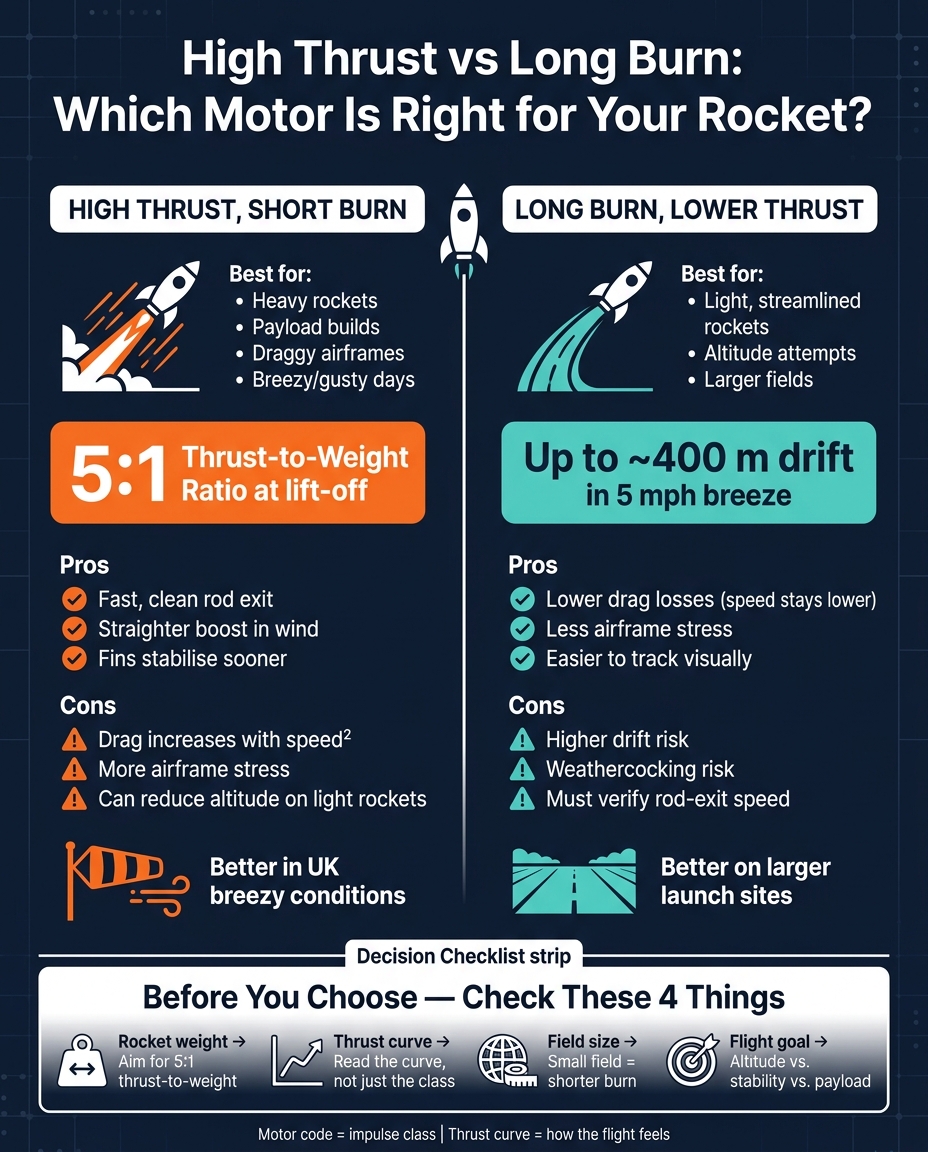
High Thrust vs Long Burn: Motor Selection Guide for Model Rockets
How to Read Rocket Motor Thrust Curves
sbb-itb-f093e97
Quick Comparison
| Motor style | Best for | Main upside | Main downside | Watch out for |
|---|---|---|---|---|
| High thrust, short burn | Heavy rockets, draggy builds, breezy launches | Fast rod exit and straighter boost | More drag at high speed, more load on the airframe | Lower altitude on some light rockets |
| Long burn, lower thrust | Light, streamlined rockets on larger fields | Lower drag loss and smoother climb | More drift, more weathercocking risk | Must still leave the rod at a safe speed |
So when I pick a motor, I look at rocket weight, field size, wind, and flight goal first. The motor code tells me the class; the thrust curve tells me how the flight will feel.
High thrust, short burn: lift-off performance and heavier rockets
Why heavier rockets need more thrust at launch
Short, high-thrust motors are a good match for heavier rockets because they deliver enough force right at the start to get the model off the rod cleanly. At lift-off, the motor needs to do more than just move the rocket - it needs to get it up to speed fast enough for a safe departure from the pad.
A common rule of thumb is a 5:1 thrust-to-weight ratio at lift-off. That means the motor’s average thrust should be at least five times the rocket’s loaded weight in Newtons. If thrust drops below that mark, the rocket can leave the rod too slowly. And that’s where things get shaky: the fins won’t have enough airflow to steady the rocket, so a straight climb becomes less reliable.
That extra margin matters even more when the rocket needs to reach a safe launch speed before the rod ends. Heavier payload rockets and draggy airframes need more initial thrust for exactly that reason. High-thrust motors help them get to a stable speed quickly, which keeps the climb straighter and more controlled.
Trade-offs of a short, punchy burn
The big upside is simple: faster, steadier lift-off. A short, high-thrust burn cuts rod time, so the fins can start doing their job sooner. In breezy UK conditions, that matters a lot. A slow rocket is more likely to weathercock, turning into the wind before it has built up enough speed to hold a straight path.
But there’s no free lunch. Drag rises with the square of velocity, so the faster a rocket moves, the harder the air pushes back. For a light, streamlined rocket, that means a punchy motor can sometimes lead to less altitude than a longer-burn option. There’s also more strain on the airframe during a hard boost, especially on the fins and couplers.
Choose high thrust when launch speed and control matter more than maximum altitude.
| Feature | High Thrust, Short Burn | Long Burn |
|---|---|---|
| Initial acceleration | High | Best covered in the next section. |
| Typical rocket type | Heavier, payload-carrying or draggy builds | Best covered in the next section. |
| Lift-off safety margin | Higher | Best covered in the next section. |
| Altitude for light rockets | Can be lower because higher speed increases drag | Best covered in the next section. |
| Airframe stress | Higher | Best covered in the next section. |
For light, streamlined rockets, the balance shifts more towards altitude, which is where long-burn motors come in.
Where Rocketry for Schools fits
For school teams picking a motor for heavier builds, Rocketry for Schools stocks options across the smaller impulse classes. Rocketry for Schools stocks Klima motors from Class A to Class D, including the Klima D9 series for heavier school builds and payload rockets.
Long burn, lower thrust: smoother flights and altitude for light rockets
When a long-burn motor can reach higher altitude
High-thrust motors are all about launch punch. Long-burn motors take a different route: they trade brute force for a steadier, more efficient climb.
The main idea is straightforward. Drag goes up with the square of speed, so if a light, low-drag rocket climbs at a lower average speed, it wastes less energy fighting the air. That’s why a long-burn motor can reach a higher apogee in the right setup. The total impulse stays the same, but it’s spread across more time. So the rocket doesn’t surge upward as fast, yet it keeps accelerating for longer.
There is one catch. The motor still has to provide enough thrust for the rocket to leave the launch rod at a safe speed.
How field size affects motor choice
Field size can change the whole decision.
On a small school field, more altitude can mean more drift. In a 5 mph breeze, a lightweight rocket can drift nearly 400 m. That’s a long way on a modest site, and it can turn a good launch into a tricky recovery.
A slower climb does have one clear upside: it’s easier to follow with your eyes. During school launches, that makes a difference. You can track the rocket more easily from lift-off to apogee, instead of losing it in a split second. On tighter sites, that trade-off matters a lot.
Trade-offs for light builds and school launches
For light school builds, the question isn’t just how hard the motor hits at lift-off. It’s also how gently it carries the rocket upward.
Long-burn motors put less stress on the airframe because the slower acceleration places less load on fins and couplers. That can suit lighter or more delicate builds well. But there’s no free lunch. A slower rocket is more likely to weathercock, or turn into the wind. And because the burn lasts longer, the rocket spends more time working against gravity, which adds gravity loss.
| Feature | High Thrust, Short Burn | Long Burn, Lower Thrust |
|---|---|---|
| Altitude potential | Lower for light, low-drag rockets | Higher for light, low-drag rockets |
| Drift risk | Lower (shorter flight time) | Higher (sustained climb, higher apogee) |
| Flight feel | Fast, hard to track visually | Slow, sustained, easy to follow |
| Airframe stress | Higher (rapid acceleration) | Lower (gentle, sustained push) |
| Suitability for delicate builds | Less ideal | Well suited |
| Stability concern | Low (reaches safe speed quickly) | Must verify launch-rod exit speed |
Matching the right motor to your rocket, field and flight goal
Stable take-off in breezy UK conditions
Once you’ve compared altitude potential, the last check is pretty simple: will the rocket leave the rod fast enough for a safe, straight climb?
In breezy UK conditions, a higher-thrust motor is often the better pick when your rocket needs a fast, steady launch off the rod. A good rule of thumb is about a 5:1 thrust-to-weight ratio at the pad. That helps the rocket get up to speed early, instead of creeping off the rod and turning into the wind.
A slow rod exit can lead to weathercocking, which is the last thing you want on a gusty day.
A simple decision guide for common flight goals
Your flight goal, field size and launch conditions usually point you towards the right motor choice.
| Scenario | Recommended motor type | Why it works |
|---|---|---|
| Heavier rocket or payload | High thrust, short burn | Gives the rocket the initial force it needs to leave the rod at a stable speed |
| Altitude attempt with a light rocket | Long burn, lower thrust | Helps reduce drag losses by keeping the rocket's speed lower |
| Small school field | A, B or C class bulk packs | Keeps height and drift within the site |
| Breezy or gusty conditions | High thrust, short burn | Faster rod exit, less weathercocking |
| Slow, easy-to-track boost | Long burn, lower thrust | Gives a slower ascent that is easier to track visually |
The motor code tells you the impulse class. The thrust curve tells you how that impulse is delivered.
Planning motors and kits with Rocketry for Schools
For school teams, motor choice works best when it fits the kit, launch gear and rocket together.
Rocketry for Schools stocks Klima motors from A to D, along with launch pads, igniter controllers, starter kits and class packs for school launches.
Conclusion: the simplest way to choose your motor
Use high thrust for heavy rockets and breezy launches. Use long burn for light rockets and for chasing altitude on bigger fields.
Here’s the plain-English version: a high-thrust motor helps a heavy rocket, or one carrying a payload, leave the rod with purpose and hold a straighter line. A long-burn motor suits a light rocket because it keeps speed lower. That matters, since extra speed throws more energy away to drag.
Field size matters every bit as much as the thrust curve. On a small launch site, a shorter-burn motor is often the safer bet.
Before launch, check these four points:
- Rocket weight: Know the fully loaded lift-off mass. Aim for about a 5:1 thrust-to-weight ratio at lift-off.
- The thrust curve: Read the curve, not just the class. A motor that builds thrust slowly may not clear the rod with enough speed.
- Field size: Match burn time to field size. Smaller fields need shorter burns; larger fields can cope with more drift.
- Flight goal: Light rockets on larger fields can often go higher on a longer burn because they lose less energy to drag.
High thrust gets you off the pad. Long burn pays off only when the rocket, the field, and the goal all line up.
FAQs
How do I read a motor thrust curve?
A motor thrust curve is a graph that shows how much force a rocket motor puts out at each point in its burn.
That matters because the motor code - such as C6-5 - only tells you the average thrust. And averages can smooth over a lot. A motor might hit hard right at the start, then settle into lower thrust for the rest of the burn.
So when you read a thrust curve, pay close attention to the instantaneous thrust at lift-off. That first burst tells you whether the motor gives the rocket enough kick to leave the rod cleanly.
This is extra important if your rocket is close to the motor’s weight limit. On paper, the average thrust may look fine. But if the initial thrust is too low, the rocket may not get up to a stable speed before it leaves the rod.
What rod-exit speed is considered safe?
For a safe launch, your rocket should reach at least 10 m/s before it leaves the launch rod or rail.
That speed gives the fins enough aerodynamic control to keep the rocket stable and helps cut the risk of weathercocking or drifting off line in the wind. In some conditions, you may need more speed, but 10 m/s is the standard UKRA threshold.
When should I choose less altitude on purpose?
Choose a lower altitude when your launch site is small. A higher flight can drift past your recovery area, which makes the rocket harder to get back. It also cuts down the time you spend tracking and chasing the rocket after launch.
A lower flight can also make sense if you're near regulated airspace or working under an altitude ceiling. And for a certification flight, the main goal is often simple: reliability, safe recovery, and staying within the permitted limits.