
Recovery Wadding vs Nomex Heat Shields
If I only fly once in a while, I’d pick paper wadding. If I fly often, I’d buy a Nomex heat shield.
Both do the same job: they stop the ejection charge from burning the parachute or streamer. The choice comes down to four plain things:
- Upfront cost
- Cost over many flights
- Packing space in the tube
- Clean-up after launch
Here’s the short version:
- Paper wadding is a one-use paper barrier. It’s cheap to start with, but I keep buying more.
- Nomex is a re-use fabric shield. It costs more at first, but after many flights the per-flight cost drops to almost nothing.
- A pack of paper wadding is about £5.04 for roughly 18–25 flights.
- A Nomex shield starts at about £3.71, and one shield can last for dozens or even hundreds of flights.
- Paper wadding gets blown out and can leave bits on the field.
- Nomex stays attached to the rocket, so there’s less mess after landing.
If you want the plain buying rule, it’s this:
- Choose paper or hemp wadding for first flights, one-off school launches, or a low starting spend.
- Choose Nomex for club flying, repeat launches, or if you want less field litter.
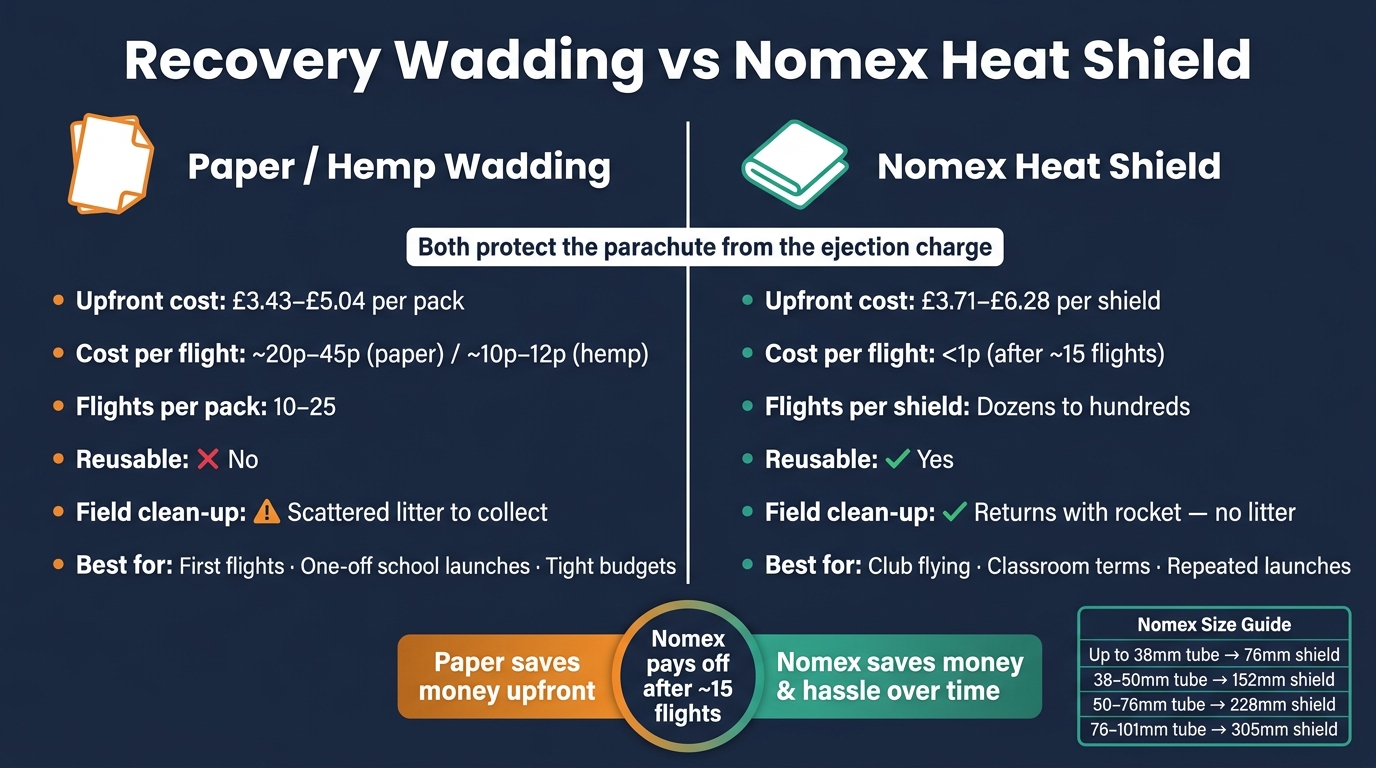
Recovery Wadding vs Nomex Heat Shield: Cost & Value Comparison
Using a Cloth Heat Shield In Your Rocket
sbb-itb-f093e97
Quick Comparison
| Option | Best for | Upfront cost | Cost per flight | Re-use | Field clean-up |
|---|---|---|---|---|---|
| Paper wadding | First flights, small rockets, one-off launches | £3.43–£5.04 per pack | About 20p–45p | No | More to collect |
| Hemp wadding | School launches | About £4.75 per pack | About 10p–12p | No | Less of an issue if left behind |
| Nomex heat shield | Clubs, term-long use, repeat flying | £3.71–£6.28 per shield | Below 1p after about 15 flights | Yes | Little to no loose litter |
So, in simple terms, paper saves money at the start, while Nomex saves money and hassle over time.
Paper recovery wadding: low cost and simple for first flights
Cost, availability, and per-flight use
Paper recovery wadding is a cheap, simple option for first flights, and it fits small body tubes well. A pack of Estes recovery wadding includes 75 sheets and costs about £5.04 inc. VAT. That works out at roughly 20p–28p per flight across 18–25 launches.
For schools, Klima natural hemp wadding comes in at about £4.75 for 40–50 launches, or around 10p–12p per flight. It’s also biodegradable.
Price matters, of course. But it’s not the whole story. Packing it neatly and clearing it up afterwards can make a big difference, especially on a school field.
Packing space, preparation, and clean-up
To use paper wadding, crumple the sheets loosely and place them above the motor mount before packing the parachute. The aim is simple: pack it loosely enough to eject cleanly, but firmly enough to block hot gas.
That sounds easy, and in small rockets it usually is. The main drawback comes after ejection. Used wadding smoulders briefly, then self-extinguishes once the heat source is removed. Even so, the scraps fall separately from the rocket and need to be collected on a school field or public launch site.
Where it isn’t practical to recover every sheet, biodegradable hemp wadding is the cleaner option.
Best fit for beginner rockets and one-off school launches
Paper wadding works especially well in small-diameter rockets. In narrow body tubes, a few loosely crumpled sheets fit without taking up much of the space needed for the parachute or streamer.
For a one-off classroom launch, the low upfront cost makes paper wadding the practical pick. It keeps consumables spending small and predictable for beginner flights.
Nomex heat shields: reusable protection for repeated flying
For repeated flights, Nomex tips things towards reuse and a cleaner recovery.
A Nomex heat shield is a small square of flame-resistant fabric. It protects the parachute or streamer from the hot ejection charge during repeated flights. Nomex resists burning and self-extinguishes if it does catch fire.
Reuse, durability, and long-term value
A 100 mm Nomex shield costs around £3.71, and a 300 mm shield around £6.28. At first glance, that's an upfront cost. But once you start flying often, the maths changes fast. One Nomex shield can last for dozens, and sometimes hundreds, of flights before it needs replacing.
Over a school term or a club season, that single purchase removes the per-flight cost of consumables. After use, rinse it in plain water and let it air-dry. Skip bleach, fabric softeners, and dryer sheets, because they can weaken the fire-resistant properties.
Tube space, wrapping method, and size selection
Size matters here. Pick a shield with a side length around 2 to 4 times the body-tube diameter. Here's a quick guide:
| Rocket Tube Diameter | Recommended Nomex Shield Size |
|---|---|
| Up to 38 mm (1.5") | 76 mm (3") square |
| 38 mm–50 mm (1.5"–2") | 152 mm (6") square |
| 50 mm–76 mm (2"–3") | 228 mm (9") square |
| 76 mm–101 mm (3"–4") | 305 mm (12") square |
Packing it is simple enough. Thread the shock cord through the corner slot, slide the shield into the tube, then wrap the parachute and shroud lines inside it to make a protected bundle. In larger rockets, that can use less space than cramming in several layers of loose paper.
Cleaner launches for clubs and school grounds
Because the shield stays attached to the shock cord, it returns with the rocket instead of ending up on the field. So there's less litter to deal with after a launch.
For school grounds and shared flying sites, that's a big plus. Paper wadding gets ejected and scattered across the field, which means someone has to pick it up later. That advantage stands out even more when you compare Nomex side by side with paper wadding.
Recovery wadding vs Nomex heat shields: direct comparison
Taken together, the trade-off is simple: paper saves money now; Nomex saves time and mess later.
Cost and value over multiple flights
Paper wadding is cheaper to buy at the start. Nomex costs more on day one, but over repeated flights it works out cheaper.
After about 15 flights, the cost per launch drops to below 1p with a Nomex shield.
| Paper Wadding | Nomex Shield | |
|---|---|---|
| Upfront cost | £3.43 – £5.04 per pack | £3.71 – £6.28 per shield |
| Cost per flight | ~20p – 45p | <1p (after ~15 flights) |
| Flights per pack/shield | 10 – 25 | Dozens of flights or more |
If you're only flying now and then, paper still makes sense. But once launches start adding up, Nomex begins to look like the better buy.
Packing, reliability, and field clean-up
Wadding is usually the fastest to pack. You just add the sheets and move on.
Nomex, though, gives you a more repeatable barrier and is less likely to let hot gases reach the recovery system. That's a big deal when you want the same setup to work flight after flight, without fiddling around each time.
There's also the clean-up issue. Paper wadding can leave loose bits scattered across the field. Nomex comes back down with the rocket, which means less rubbish to pick up after launch.
Which option suits beginners, clubs, and classrooms
The best choice depends on how you're flying and who it's for.
| Scenario | Recommended Option | Reason |
|---|---|---|
| First rocket flight | Paper wadding | Low cost and often included in starter sets |
| School launch | Hemp wadding | Lower upfront cost and biodegradable on school grounds |
| Club launch | Nomex shield | Cleaner launch site and reliable after repeated flights |
| Classroom term | Nomex shield | Better value over a term-long flying programme |
For occasional flights, paper wadding is a simple pick. For repeated launches, Nomex is usually the smarter option.
Where to buy kits, motors, and recovery supplies in the UK
Useful for school orders, club flying, and starter setups
If you want to get the right recovery material in the same order as your launch gear, a UK supplier can make life much easier. Rocketry for Schools sells starter kits, class packs, rocket motors, launch pads, and igniter controllers, with prices shown in pounds sterling and VAT included.
For schools and clubs, class packs and launch-pad bundles make one-order buying simpler. That helps keep class orders straightforward and priced in GBP.
Conclusion: Which option to choose for your rocket
Choose based on how often you fly and what your launch site is like. Paper wadding is the low-cost, no-fuss option for occasional launches. It keeps upfront spend down and is easy to use, which makes it a good starting point if you're new to the hobby. A pack of Estes recovery wadding costs about £5.04 and covers roughly 18–25 flights.
Nomex heat shields start at £3.71 for a 100 mm × 100 mm square. They stay with the rocket, don’t leave litter behind, and after you’ve bought one, the cost per flight is close to nothing. If you launch often, Nomex cuts mess, saves a bit of prep time, and removes the need to keep buying consumables.
Rocketry for Schools stocks both for class and club orders.
A simple buying rule for UK readers
Use this rule of thumb:
- Choose paper or hemp wadding for first flights, single school launches, or tight budgets.
- Choose a Nomex heat shield for repeated flights, club use, or cleaner launch sites.
FAQs
How do I know which Nomex size to buy?
Choose a Nomex heat shield that's about 2 to 4 times the diameter of your rocket’s body tube. In most cases, that gives you enough material to wrap around the parachute and shield it from ejection gases.
Just make sure it still slides into the tube without a struggle. If the shield is too large or too bulky, it can jam the recovery system.
Can I use Nomex in very small rockets?
Yes, but with the smallest rockets, Nomex can be a bit too stiff. If the fit is too tight, it can sometimes cause a jam.
For very narrow tubes, standard wadding is often the better option. If you do use Nomex, pick a small enough piece so the parachute can deploy without getting blocked.
When does Nomex become cheaper than paper wadding?
Nomex makes more sense on larger rockets, especially when a single launch would chew through a lot of paper wadding.
Because you can use it again across many flights, you don’t need to keep buying and packing disposable wadding every time. Paper wadding is still a low-cost, dependable option for standard launches. Nomex, on the other hand, is better seen as a longer-term investment.