
Team Rocketry Guide For Schools And Clubs
If I want a school or club rocketry project to run well, I need five things in place from the start: clear roles, adult-led safety, a fixed launch routine, flight data, and a simple budget. That is the whole job in one line.
In this guide, I’m looking at how a UK team can run a rocket project from first briefing to final review. The article covers the 5 project stages - briefing, build, pre-flight, launch, and review - plus who does what, how motors and igniters are controlled, what happens on launch day, and how pupils use altitude and flight-time data to improve the next flight.
Here’s the short version:
- Pupils work in small teams with set jobs such as Build Lead, Range Safety, Launch Caller, Data Tracker, and Recovery Lead
- Adults keep control of safety at every stage, with the highest level outdoors during motor handling and launch
- Motors are only handled at supervised outdoor sessions and should stay in original packaging in a cool, dry, secure place
- Every flight follows the same order: build check, range check, countdown, launch, recovery, review
- Data matters: pupils compare predicted altitude with actual results using tools like a clinometer and stopwatch
- A short debrief after each launch turns results into the next design change
- Budgeting is part of the project, with class packs from £85, starter kits at about £220, motors from £38, and launch gear from £53
A few points stand out straight away:
- The project is built around teamwork and checking each other’s work
- The science link is clear: Newton’s Third Law, F=ma, motion equations, drag, stability, thrust, and weight
- UK groups should match their plans to CLEAPSS guidance and follow the UKRA Safety Code
- A misfire is handled with a fixed rule: wait at least 60 seconds before anyone goes near the pad
| Area | What I need to have sorted |
|---|---|
| Team setup | Small groups, shared goal, rotating roles |
| Safety | Written risk assessment, adult supervision, UKRA/CLEAPSS checks |
| Motor control | Outdoor handling only, secure storage, safety-key controller |
| Launch routine | Safe-distance line, audible countdown, range-clear check |
| Review | Logbook, motor code, altitude, flight time, damage notes |
| Budget | Kits, motors, launch gear, wadding, adhesives, spare igniters |
In short: if I keep the structure tight and the safety rules clear, pupils get a hands-on rocket project that links physics, design, and teamwork in a way that is easy to run and easy to review.
NASA's Student Launch Overview

sbb-itb-f093e97
Set up the team and assign clear roles
Once the project stages are mapped out, give each pupil a clear job and make sure one person owns it.
Choose team size, structure and shared goals
For most school and club projects, small groups work best. Keep the build work in pairs so pupils can check each other’s work as they go.
After the groups are set, agree on one simple shared goal before anything else. That could be a stable flight, a clean parachute deployment, or hitting a target altitude.
Assign build, safety, launch and data roles
The main roles are Build Lead, Range Safety, Launch Caller, Data Tracker, and Recovery Lead.
It also helps to rotate some jobs between flights. Swap the Launch Caller and Data Tracker each time, and change Range Safety every two or three launches. That way, pupils don’t stay in one lane the whole time. They start to see how the full launch process fits together and what each role asks of them.
Role table: duties, oversight and rotation schedule
| Role | Core Duties | Adult Oversight | Rotation Schedule |
|---|---|---|---|
| Build Lead | Assembles the body tube, fins, nose cone and recovery system; checks glue joints and fin alignment | Adult checks alignment and joint quality | Per build session |
| Range Safety | Runs the range checklist, carries out range-clear checks and follows the approved safety code | Critical - must align with CLEAPSS/UKRA safety codes | Every 2–3 launches |
| Launch Caller | Delivers the safety briefing; conducts the audible countdown; operates the electrical ignition controller | Adult supervises safe ignition distance | Every launch |
| Data Tracker | Uses a clinometer and stopwatch; logs flight data, recovery results and compares them with pre-flight predictions | Adult reviews data for altitude calculations | Every 2–3 launches |
| Recovery Lead | Tracks the rocket’s descent; retrieves the model; reports on parachute deployment | Adult confirms site boundaries are observed | Every launch |
Use simple templates for the logbook and schedule so launch-day checks stay tight and easy to follow.
These roles only work if motors, igniters, and launch gear are handled under strict adult supervision. With the team roles in place, the next step is to control motors, igniters, and tools under adult supervision.
Build safely and handle motors correctly
With roles in place, the team can run a short, controlled routine at the launch site. Model rocket motors are classed as UN 1.4S explosives, so they need close control.
Motor storage and handling rules
Keep motors in their original packaging and store them in a secure, cool, dry place away from heat and friction. Motors, igniters and flame should stay out of indoor build spaces. Handle motors only during supervised outdoor launch sessions, and never use damaged motors.
Prepare rockets and ignition systems under supervision
Before fitting any motor, the Build Lead should confirm that the rocket has passed a swing test, with the centre of mass ahead of the centre of pressure. An adult should also check fin alignment and glue joints.
Only after that should the Range Safety Officer issue a motor from the secure container. The split of duties is simple:
- The Build Lead checks stability
- The Range Safety Officer issues motors
- The Launch Caller handles ignition only when the range is clear
Use only electrical igniters and a controller with a safety key. Leave the safety key out until the range is clear, the countdown is complete and everyone is at a safe distance.
Safety table: storage, handling and misfire steps
Use the checks below to keep storage, transport and ignition steps consistent.
| Key Rule | Responsible Person | Adult Sign-off |
|---|---|---|
| Storage: Motors in original packaging, secure, cool, dry locker | Lead Teacher / Club Leader | Required |
| Transport: Move motors to the site in a closed rigid container | Designated Adult | Required |
| Motor Issue: Hand out motors only at the designated prep area, just before launch | Range Safety Officer | Required |
| Ignition Check: Safety key removed; range clear; audible countdown completed | Launch Caller (Pupil) | Required |
| Misfire: Wait at least 60 seconds; engage the safety pin before approaching the pad | Range Safety Officer | Required |
UK schools should match their written risk assessment to CLEAPSS guidance on solid-propellant motors and ignition systems before any launch takes place. If the school is new to rocketry, it helps to ask an experienced mentor to review the risk assessment and launch procedure before the first flight. Once motors and igniters are under control, the team can move on to pad setup, launch order and countdown.
Run launch day as a coordinated team activity
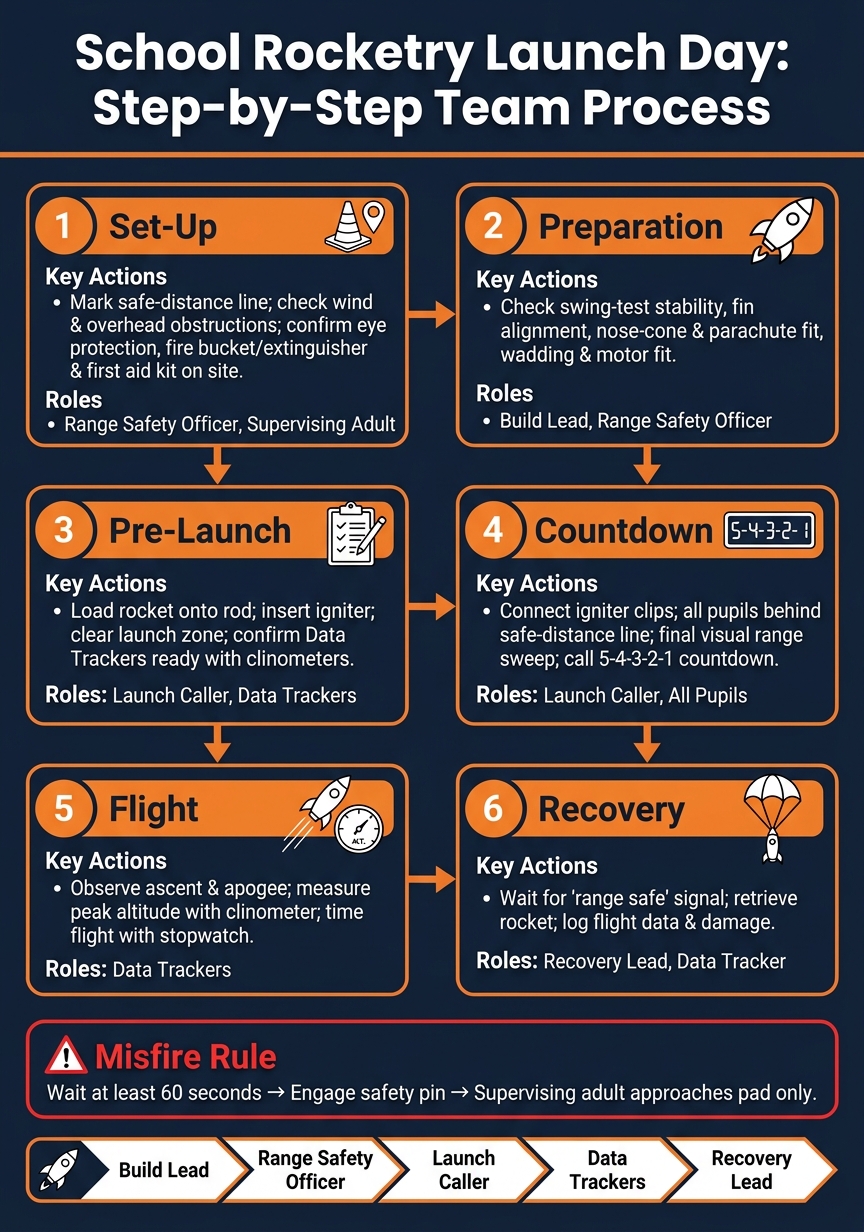
School Rocketry Launch Day: Step-by-Step Team Process
With roles and motors already assigned, launch day should follow one fixed sequence. Start with a 10-minute safety briefing. Confirm the range boundaries, and make sure eye protection, a fire bucket or extinguisher, and a first aid kit are all on site before anything else begins.
Set up the site, zones and launch order
Pick an open area that is well clear of buildings, people, dry vegetation, and overhead obstructions. Mark a clear safe-distance line and keep all pupils behind it during ignition. Place the ignition controller away from the pad.
Before setup starts, the Range Safety Officer and the supervising adult check the wind conditions. Launches should only go ahead in low wind and clear conditions. To keep things orderly, use a rotation system: the next team waits at the prep table until the range is declared clear.
Pre-launch checks, countdown and recovery steps
Once the rocket is on the pad, the Build Lead checks swing-test stability, fin alignment, nose-cone and parachute fit, wadding, and motor fit. After that, the Range Safety Officer inserts the igniter and connects the clips, then everyone moves back behind the safe-distance line. The audible 5-4-3-2-1 countdown starts only after the Launch Caller has done a final visual sweep and confirmed that the range is clear.
After launch, Data Trackers use clinometers and stopwatches to record peak altitude and flight time. When the rocket lands, nobody moves until the Range Safety Officer calls "range safe". Pupils must not catch a descending rocket. The Recovery Lead then collects the rocket and passes it to the Data Tracker, who logs altitude, flight time, and any visible damage. Those notes feed into the flight review.
Launch process table: preparation to recovery
The hand-off stays in this order: Build Lead → Range Safety Officer → Launch Caller → Data Trackers → Recovery Lead. That sequence helps every team work through the same steps without confusion.
| Phase | Key Actions & Safety Checks | Roles Involved |
|---|---|---|
| Set-up | Mark the safe-distance line; check wind and overhead obstructions; confirm eye protection, a fire bucket or extinguisher and a first aid kit are on site | Range Safety Officer, Supervising Adult |
| Preparation | Check swing-test stability, fin alignment, nose-cone and parachute fit, wadding and motor fit | Build Lead, Range Safety Officer |
| Pre-launch | Load rocket onto the rod; insert igniter; clear the launch zone; confirm Data Trackers are ready with clinometers | Launch Caller, Data Trackers |
| Countdown | Connect igniter clips; keep all pupils behind the safe-distance line; complete a final visual sweep of the range; call the 5-4-3-2-1 countdown | Launch Caller, All Pupils |
| Flight | Observe ascent and apogee; measure peak altitude with a clinometer; time the flight with a stopwatch | Data Trackers |
| Recovery | Wait for the "range safe" signal; retrieve the rocket; log flight data and damage | Recovery Lead, Data Tracker |
If there is a misfire, wait at least 60 seconds, engage the safety pin on the controller, and allow only the supervising adult to approach the pad. After recovery, the next team can move to the prep table.
Review results, keep everyone involved and plan equipment
Review each flight with data and a short debrief
After recovery, use the results to close the loop before the next build. Once the recovery team hands the rocket back, run a focused 15-minute debrief before everyone packs up. The aim is simple: turn flight data into the next design change.
The trackers can read out the recorded altitude and flight time, and the team can compare those figures with the pre-flight altitude estimate. If predicted and actual apogee don't match, pupils have something concrete to dig into. That gap can help them look at the effect of drag instead of just talking about it in theory.
Record the motor code with every result so pupils can connect flight performance to motor choice. A code such as A6-4 shows the impulse class (A), average thrust (6 Newtons), and ejection delay (4 seconds from burnout to parachute deployment). Put all of it in a project logbook so nothing gets lost between sessions.
Keep the debrief centred on one question: what changes for the next flight? Pupils should back up any proposed change - a different fin shape, adjusted mass, or a higher impulse motor - with the data they have just collected, not guesswork.
Keep all pupils involved across every session
Then switch roles so the next session gives different pupils build, data, and recovery jobs. One simple way to do this is with paired build roles. Two pupils share each task, which gives quieter members a clear part to play and spreads responsibility across the group.
For mixed-attainment groups, pre-cut fin templates and alignment jigs can help pupils who need more support. At the same time, more confident pupils can design fin variants or test one variable, such as mass or motor impulse. During evaluation, structured writing frames help all pupils connect their findings to thrust, weight, drag, and stability. That keeps the science link clear instead of letting the write-up drift into vague comments.
Plan kits, motors and class packs with Rocketry for Schools
If the team is ready for another cycle, plan equipment around repeat builds and fair comparisons. Rocketry for Schools supplies the kits, motors, launch gear, and payload electronics used in school and club projects. 10-rocket class packs start from £85, which makes per-pupil budgeting simple. Starter kits, at about £220 for a ready-to-fly bundle, suit clubs running their first sessions. Build kits are a good fit once teams are more confident with assembly. Motor six-packs start from £38, and launch pad and igniter controller bundles from £53.
When setting a budget in GBP, include consumables - wadding, adhesives, and spare igniters - as well as one-off hardware costs. Rocketry for Schools also supplies payload electronics for teams that want to add data collection or other payload projects to their flights. That feeds straight back into the debrief stage above.
| Equipment Category | Key Items | Approx. Cost (GBP) |
|---|---|---|
| Class Packs | 10-rocket build kits | From £85 |
| Starter Kits | Ready-to-fly bundle | About £220 |
| Motors | 1.4S motor six-pack | From £38 |
| Launch Gear | Launch pad and igniter controller bundle | From £53 |
| Consumables | Wadding, epoxy-resin adhesive, spare igniters | Variable |
FAQs
What age group is this suitable for?
Rocketry projects can work well for many pupils. Younger children might focus on simple builds and careful observation. Older students can move into more advanced engineering, data analysis, and payload integration.
Programmes such as the UK Youth Rocketry Challenge are aimed at pupils aged 11 to 18. Whatever the age group, these activities need constant supervision from a teacher or other responsible adult to keep everyone safe.
How many adults should supervise a launch?
A teacher or supervising adult must always oversee rocket launches. There isn’t a set number of adults required, but safe range management comes down to one thing: clear roles.
At a minimum, appoint a Range Safety Officer to watch the site, spectators and weather, and a Launch Control Officer to handle ignition.
For larger events, you may also need extra staff for:
- tracking
- recovery
- staff rotation
That way, no one person is trying to do everything at once.
What data should pupils record after each flight?
After each flight, pupils should record the launch time, weather conditions, estimated altitude, flight duration, rocket stability and trajectory, and the recovery outcome.
It also helps to keep a project logbook with photos or videos from each launch. That gives pupils a clear record of what happened, not just what they remember afterwards.
Once they’ve gathered a few launches, they can work out average altitudes and compare the actual results with their pre-launch predictions. That makes it easier to see how design changes, rocket mass, or motor choice affect performance.